17 September 2026
Choosing a Regenerative Injectable in 2026: PCL, PLLA, CaHA and Collagen Explained
How should regenerative injectables be selected? As regenerative medicine and aesthetic technologies continue to evolve, PCL, PLLA, CaHA and collagen-based injectables have become important options in professional aesthetic practice. With more products entering the market, terminology has also become increasingly diverse. Names such as “girl injection,” “baby-face injection,” “bone injection” and “collagen injection” may attract attention, but the name alone does not explain how a product actually works.

The material name is only the starting point. What matters is the complete product profile — including composition, physical characteristics, indications, mechanism, injection plane and clinical evidence.
Regenerative injectables are not simply about “putting material into tissue.” Depending on the material, they may provide immediate structural support, volume enhancement, or progressive biological stimulation and tissue remodelling.
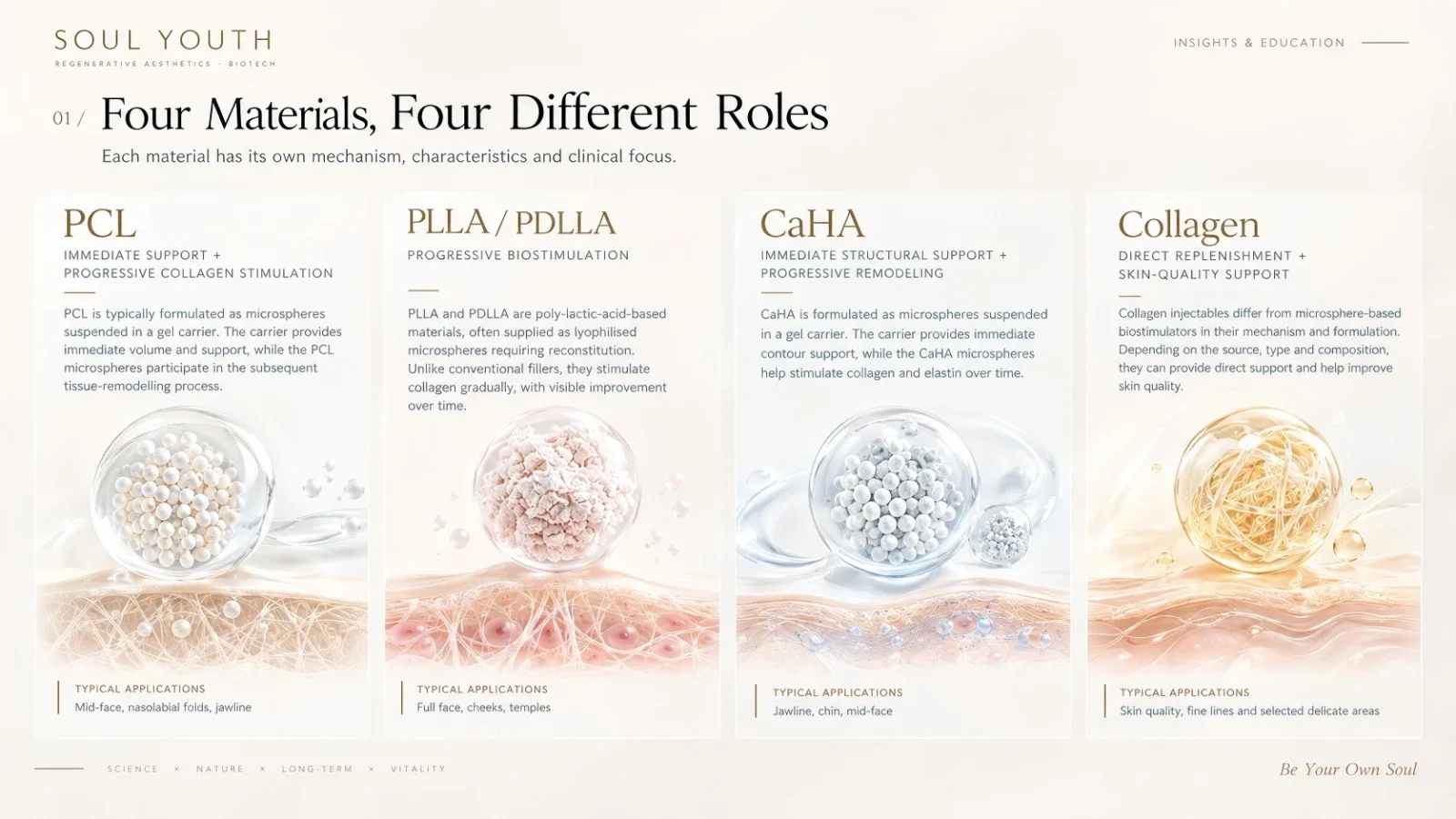
01 | Four Materials, Four Different Roles
PCL | Immediate Support + Progressive Collagen Stimulation
PCL, or polycaprolactone, is commonly formulated as microspheres suspended in a gel carrier.
The carrier can provide immediate volume and support, while the PCL microspheres participate in the subsequent tissue-remodelling process.
Its overall concept can therefore be described as:
Immediate support + Progressive collagen stimulation
PCL-based products may be considered for areas such as the mid-face, nasolabial folds and jawline where structural support is required.
Because PCL-based products are generally not reversible with hyaluronidase, careful patient assessment, product selection, injection depth and dosing are particularly important.
PLLA / PDLLA | Progressive Biostimulation
PLLA, or poly-L-lactic acid, and PDLLA, or poly-D,L-lactic acid, belong to the poly-lactic-acid family.
Some products are supplied as lyophilised microspheres and require reconstitution according to the product instructions.
Unlike conventional immediate fillers, the key characteristic of PLLA / PDLLA is:
Gradual improvement rather than immediate volumisation.
Changes generally develop progressively over time, making this approach suitable for treatment strategies where natural and gradual improvement is preferred.
Applications may include diffuse facial volume loss, the cheeks, temples and broader facial rejuvenation programmes.
Treatment outcomes can be influenced by reconstitution, injection plane, distribution and treatment protocol. Product-specific instructions should always be followed.
CaHA | Immediate Structural Support + Progressive Remodelling
CaHA, or calcium hydroxyapatite, is commonly formulated as microspheres suspended in a gel carrier.
The carrier can provide immediate volume and contour support, while the CaHA microspheres participate in subsequent tissue remodelling.
Its overall concept can therefore be described as:
Immediate structural support + Progressive tissue remodelling
Common treatment areas may include the jawline, chin and mid-face where structural support is required.
Certain CaHA products may also be used in selected skin-quality applications after appropriate dilution. Specific indications, treatment areas and techniques must always follow the applicable product information and local regulations.
Collagen | Direct Replenishment + Skin-Quality Support
Collagen injectables differ from microsphere-based biostimulators in their fundamental mechanism and formulation.
Their primary concept is:
Direct collagen replenishment and skin-quality support.
Collagen products may differ significantly depending on their source, collagen type and formulation.
Animal-derived collagen may provide relatively direct support, while some products require appropriate skin-sensitivity assessment.
Recombinant collagen is produced through biotechnology, and different products may be developed around different collagen types and intended applications.
Therefore, “collagen” alone is not enough to evaluate a product. Its source, collagen type, concentration, indications and clinical evidence should also be considered.
02 | The Comparison at a Glance
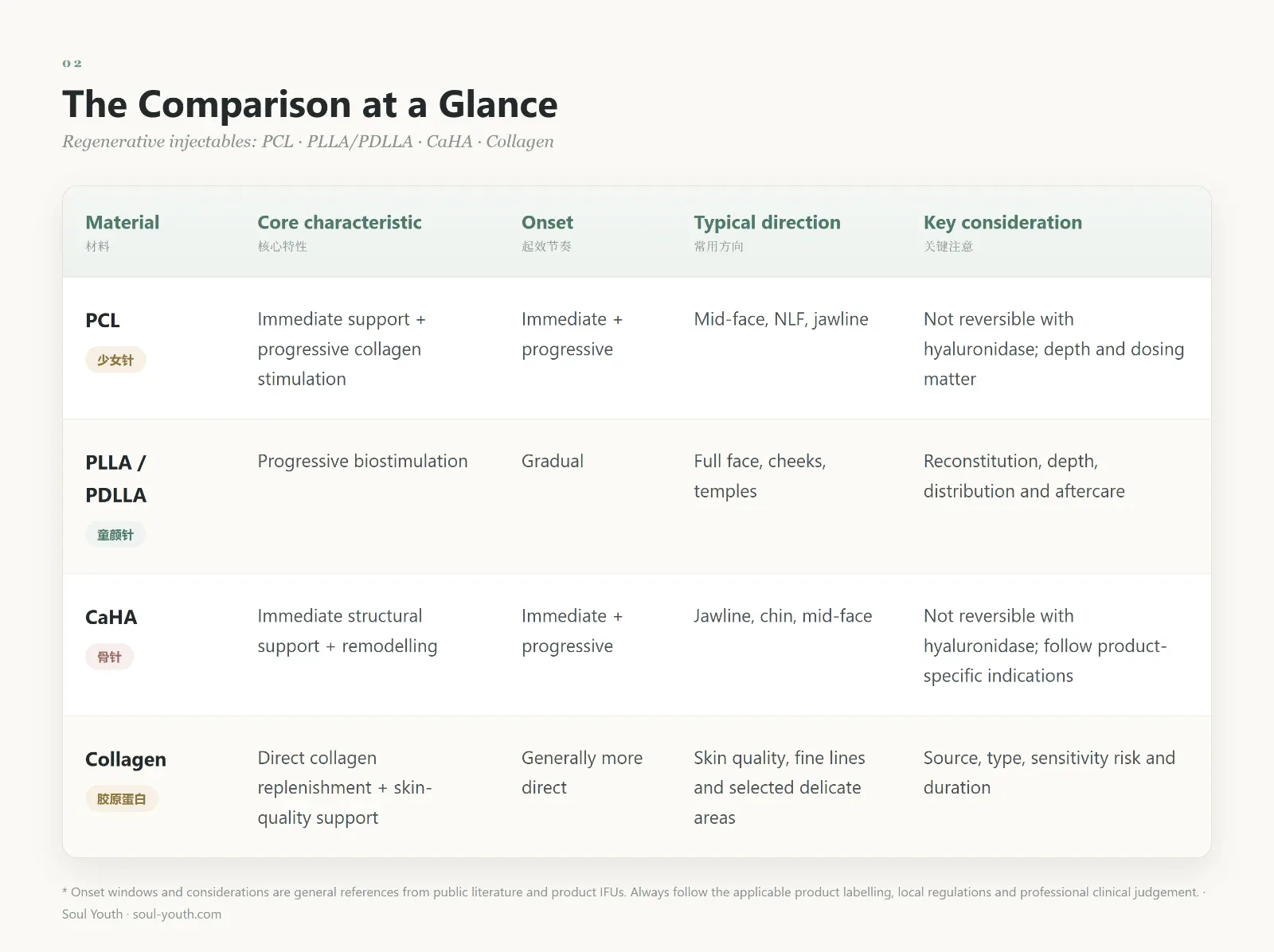
The above is a general material-level comparison. Actual outcomes depend on the specific product formulation, concentration, particle characteristics, injection technique, treatment area and individual factors.
03 | Choose by the Treatment Goal, Not by the Trend
The key clinical question is not:
“Which material is the strongest?”
It is:
“What does this patient need to address first?”
Scenario A | Weak Skin Foundation
When the primary concerns are dryness, rough texture, fine lines or reduced skin quality, the treatment strategy may first focus on supporting the skin foundation.
Possible directions include:
PDRN + HA products, collagen-based products and other skin-quality approaches.
Scenario B | Natural, Progressive Rejuvenation
If the goal is not a dramatic one-time transformation but a gradual and natural improvement, a progressive biostimulation approach may be considered.
One possible direction is:
PLLA / PDLLA.
Scenario C | Lack of Structural Definition
When the primary concern involves an unclear jawline, chin proportion or mid-face structural support, the treatment strategy may focus on structural enhancement.
Depending on the specific product indications and clinical assessment, possible directions include:
CaHA / PCL.
Scenario D | Fine Lines and Skin Quality
For selected cases where the primary goals are fine lines, skin quality and subtle refinement, the focus may be:
Skin quality rather than structural volumisation.
The appropriate material and injection technique should be determined according to anatomy, treatment objectives and the applicable product information.
04 | Three Questions to Ask Before Selecting a Product
① Where is the product approved for use?
Even within the same material category, different products may have very different approved indications.
Before selecting a product, review:
Approved indications
Intended treatment areas
Contraindications
Warnings and precautions
The same material does not necessarily mean the same indication.
② What is the product profile beyond the material name?
Two products may both be described as “PLLA” or “CaHA”, while differing significantly in:
Microsphere size
Particle distribution
Material concentration
Carrier system
Reconstitution method
Rheological properties
Clinical evidence
Administration requirements
Therefore:
Material is only the beginning. The product profile matters.
③ What is the plan if the outcome is not ideal?
For certain biostimulatory materials that cannot be reversed with hyaluronidase, careful pre-treatment assessment becomes particularly important.
The treatment pathway should consider:
Patient assessment → Product selection → Injection technique → Follow-up → Management
A well-designed treatment plan should consider not only how to achieve the intended outcome, but also how unexpected nodules, irregularities or dissatisfaction will be evaluated and managed.
05 | The Soul Youth Platform Range
The Soul Youth portfolio is structured around three complementary treatment pathways:
REPAIR | Build the Foundation
PDRN + HA
REPAIR is positioned around skin-quality support and the foundation stage of a staged treatment approach.
The combination of PDRN and HA is designed to support the skin foundation before progressing to structural treatment considerations.
REVIVE | Progressive Regeneration
PLLA
REVIVE combines PLLA microspheres with HA and trehalose.
Its uniform microsphere characteristics are designed to support suspension stability and distribution following reconstitution.
Its core positioning is:
Progressive collagen-supported renewal
REVIVE is available in 90 / 150 / 300 / 450 / 600 mg configurations, with microsphere sizes of approximately 20–50 μm.
Specific reconstitution procedures, dosage, injection plane and treatment intervals should always follow the applicable product instructions.
LIFT | Structural Support
CaHA
LIFT combines CaHA microspheres with a cross-linked HA gel carrier.
The HA gel provides immediate volume and contour support, while the CaHA microspheres participate in the subsequent tissue-remodelling process.
Its core positioning is:
Immediate contour support + Progressive remodelling
The three pathways can be summarised as:
REPAIR — Build the Foundation
REVIVE — Progressive Regeneration
LIFT — Structural Support
06 | Staged Treatment: Regeneration Is a Process
Regenerative treatment is not simply about choosing one product.
For selected facial rejuvenation strategies, the sequence of treatment can be equally important.
Stage 1 | Assess & Build
Begin with an assessment of:
Skin condition
Facial anatomy
Previous treatments
Treatment goals
Recovery needs
Where the skin foundation is weak, skin-quality support may be considered first.
Stage 2 | Regenerate & Support
Based on the primary treatment objective, select a progressive biostimulation or structural-support pathway.
Treatment intervals, dosage and administration should follow the specific product information.
Stage 3 | Review & Maintain
Following treatment, reassess the response and adjust future care according to individual needs.
Maintenance is not necessarily a fixed schedule. It should be guided by ongoing assessment.
Assess → Treat → Review → Maintain
Regenerative aesthetics is not a single treatment.
It is a process.
Conclusion | There Is No Single “Best” Material
So, how should regenerative injectables be selected in 2026?
The answer is not to find the “strongest” material.
A more appropriate framework is:
Start with the treatment goal → understand the material → review the product profile → apply professional clinical judgement.
PCL, PLLA, CaHA and collagen each have different material characteristics and treatment roles.
The most professional approach is not to follow market trends, but to create a better match between:
Material × Product × Treatment Goal × Clinical Need
Professional Disclaimer
This article is intended for licensed healthcare professionals as a general educational reference only. It does not constitute medical advice, diagnosis or an individualised treatment recommendation.
Specific indications, administration methods, injection planes, dosage, treatment intervals, contraindications, warnings, potential risks and other requirements must always be determined according to the applicable product instructions and local regulatory requirements.
All treatment decisions should be made by appropriately qualified healthcare professionals based on individual patient assessment, clinical judgement and applicable product information.
Soul Youth · Be Your Own Soul
Regenerative Aesthetics · Biotech
PDRN · PLLA · CaHA
Specifications, terms and registration status.
Our team supports licensed clinics, distributors and OEM partners — tell us what your market needs.