16 July 2026
HA + CaHA Hybrid Fillers: The Science Behind Immediate Support and Long-Term Collagen Remodeling
Discover how hybrid HA + CaHA fillers combine immediate volumizing effects with progressive collagen stimulation. Learn the science behind calcium hydroxylapatite, facial contouring, and regenerative aesthetics.

A hybrid HA + CaHA filler pairs immediate support from cross-linked hyaluronic acid with calcium hydroxyapatite microspheres studied for collagen stimulation. The combination is positioned for contour support where a clinic wants both an immediate and a gradual component in one product.
From Volume Replacement to Structural Regeneration
For many years, facial fillers were primarily designed to replace age-related volume loss. While this approach remains important, aesthetic medicine has increasingly shifted toward treatments that not only restore facial contours but also improve tissue quality through biological remodeling.
This evolution has driven growing interest in hybrid fillers that combine hyaluronic acid (HA) with calcium hydroxylapatite (CaHA) microspheres.
Rather than relying on a single mechanism of action, hybrid formulations aim to provide:
Immediate structural support
Progressive collagen stimulation
Long-term extracellular matrix (ECM) remodeling
More natural and durable aesthetic outcomes
What Is Calcium Hydroxylapatite (CaHA)?
Calcium hydroxylapatite (CaHA) is a synthetic biomaterial with a long history of medical use. In aesthetic medicine, CaHA is formulated as smooth microspheres suspended within a gel carrier.
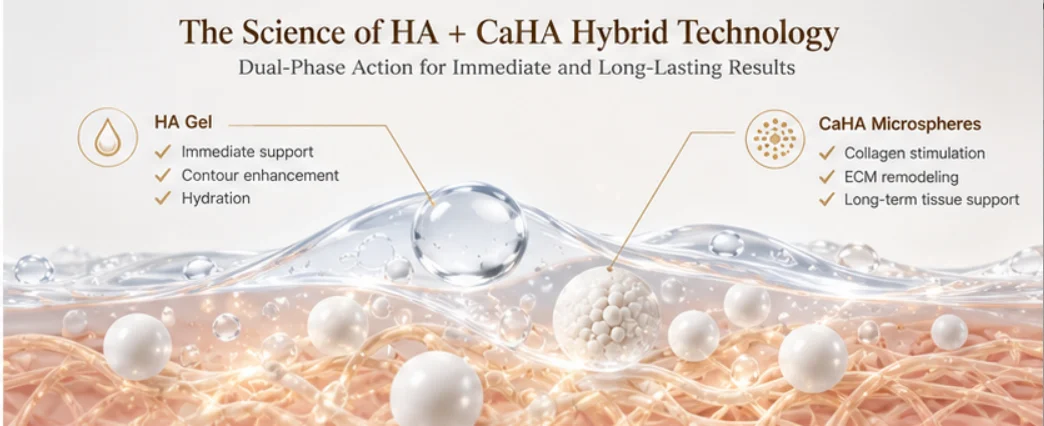
Unlike conventional fillers that primarily occupy space, CaHA functions through two complementary phases:
Immediate Phase
The carrier gel provides:
Structural support
Facial contour enhancement
Immediate correction of volume loss
Regenerative Phase
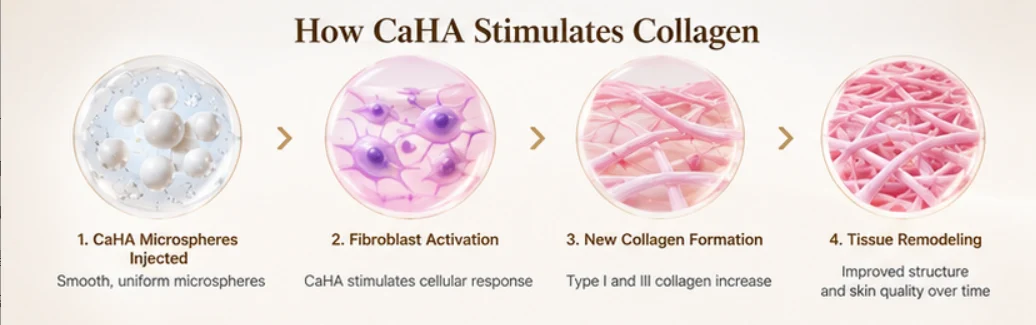
As the carrier gel gradually resorbs, CaHA microspheres remain temporarily within the tissue, where they support fibroblast activation and extracellular matrix remodeling. This biological response has been associated with the gradual formation of new collagen, contributing to improved tissue quality and structural support over time.
Why Combine HA and CaHA?
The rationale behind hybrid fillers lies in the complementary functions of their two components.
Hyaluronic Acid (HA)
Immediate hydration
Instant volumizing effect
Smooth contour correction
Tissue lubrication
Calcium Hydroxylapatite (CaHA)
Progressive collagen stimulation
ECM remodeling
Long-term structural support
Fibroblast activation
Rather than competing technologies, HA and CaHA address different stages of facial rejuvenation.
HA provides the immediate aesthetic improvement patients can see immediately after treatment, while CaHA contributes to gradual biological remodeling over the following months.
CaHA vs PLLA: Different Biostimulators for Different Clinical Goals
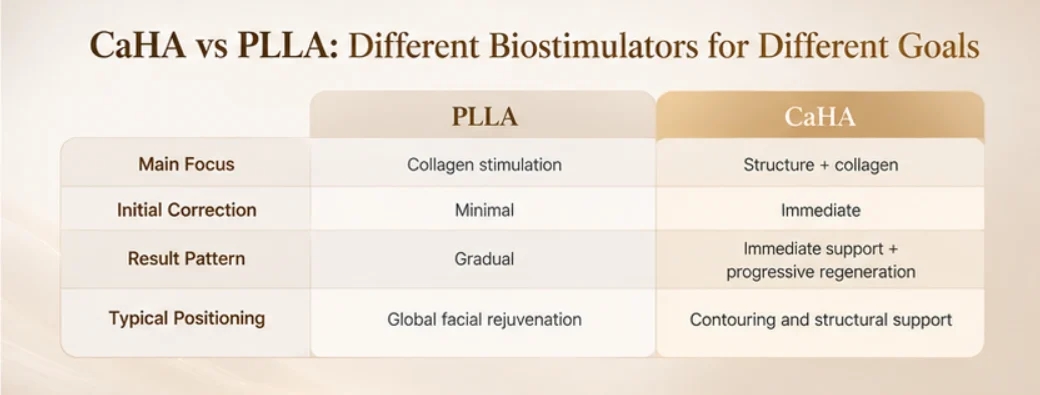
Both poly-L-lactic acid (PLLA) and calcium hydroxylapatite (CaHA) are widely recognized collagen biostimulators, yet they exhibit distinct treatment characteristics.
Primary Mechanism — PLLA: Progressive collagen biostimulation · CaHA Gel: Immediate structural support plus collagen biostimulation
Initial Effect — PLLA: Limited and temporary; visible results develop gradually · CaHA Gel: Immediate support and contour enhancement
Result Pattern — PLLA: Gradual, diffuse and regenerative · CaHA Gel: Immediate correction followed by progressive tissue remodeling
Typical Treatment Goal — PLLA: Broad volume restoration and global facial rejuvenation · CaHA Gel: Structural contouring, projection and tissue support
Common Clinical Positioning — PLLA: Temples, midface and broader facial volume loss · CaHA Gel: Midface, chin, jawline and lower-face contouring
Both PLLA and CaHA are collagen biostimulators, but PLLA is primarily associated with gradual, broader tissue regeneration, while CaHA can provide immediate structural support followed by progressive collagen remodeling. Clinical use depends on product formulation, dilution, injection technique and treatment goals.
Rather than determining which material is "better," clinicians generally select the product based on treatment objectives, facial anatomy, and desired aesthetic outcomes.
Injection Strategy Matters More Than Material Alone
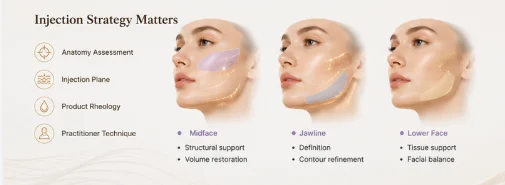
The clinical performance of regenerative fillers depends not only on the biomaterial itself but also on appropriate treatment planning.
Successful outcomes are influenced by:
Anatomical assessment
Injection depth
Product rheology
Volume distribution
Practitioner experience
Examples include:
Midface
Structural projection
Volume restoration
Jawline
Definition
Contour refinement
Lower Face
Tissue support
Facial balance
The Future of Hybrid Regenerative Aesthetics
The next generation of facial rejuvenation is moving beyond the concept of "filler versus biostimulator."
Instead, regenerative treatment strategies increasingly combine multiple complementary technologies, including:
HA for immediate structural support
CaHA or PLLA for collagen remodeling
PDRN or PN technologies for skin quality optimization
The goal is no longer simply to replace lost volume, but to support healthier tissue architecture and achieve natural-looking, long-lasting rejuvenation through biologically informed treatment planning.

References
Specifications, terms and registration status.
Our team supports licensed clinics, distributors and OEM partners — tell us what your market needs.