5 October 2026
Microfluidic Technology: How Precision Engineering Enables Advanced Microsphere Manufacturing
Mixing, separating, cutting, and shaping… These processes may sound like complex industrial manufacturing techniques. However, when these operations take place within microscopic channels, they become part of an emerging technology that is transforming the development of advanced biomaterials — microfluidic technology.
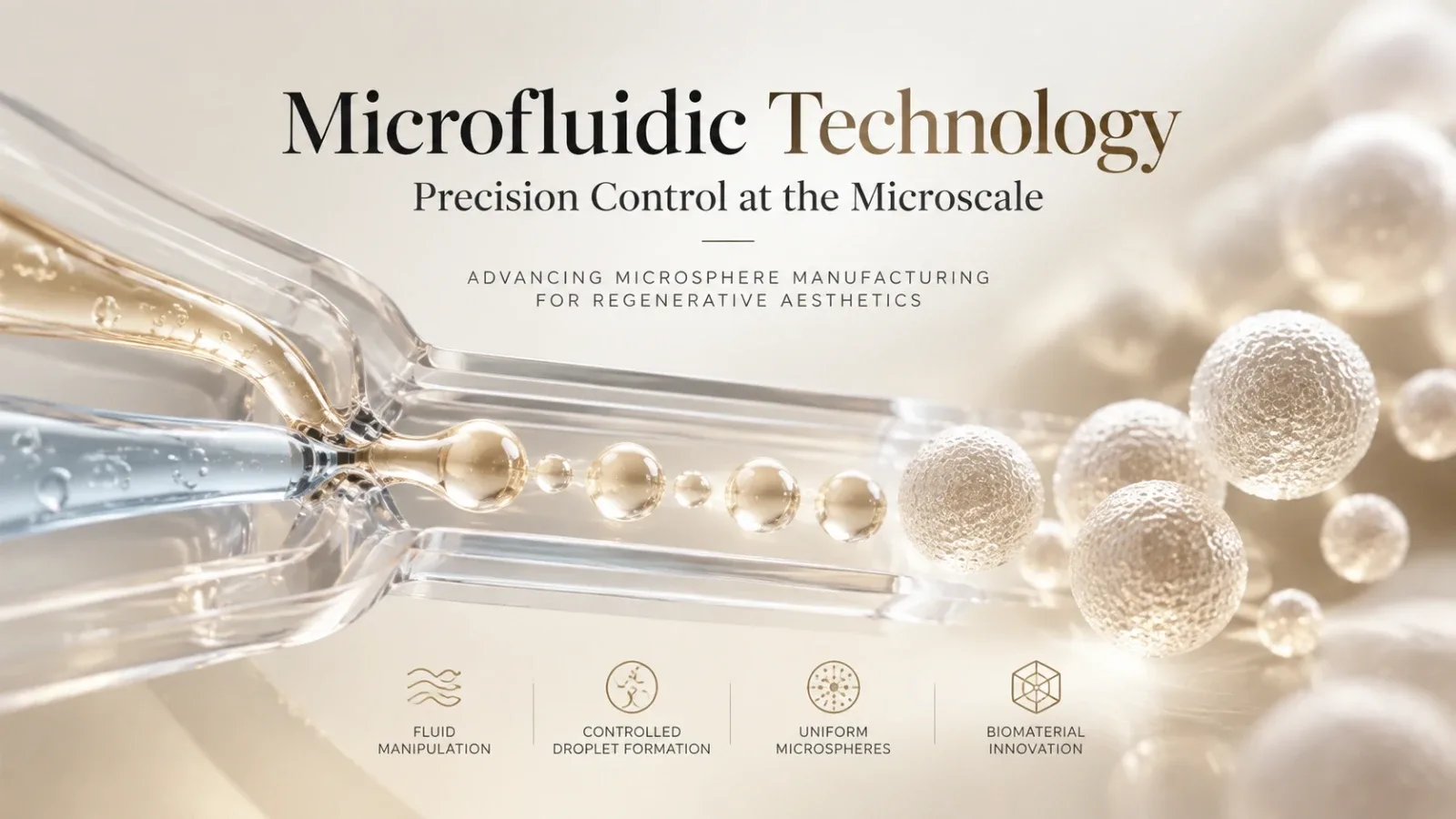
In regenerative aesthetics, many innovative materials are developed in the form of microspheres or microparticles. The size, morphology, and consistency of these microspheres can significantly influence material design and product performance.
Therefore, achieving precise and controlled microsphere manufacturing has become an important direction in the advancement of regenerative medicine materials.
What Is Microfluidic Technology?
Microfluidic technology is an engineering approach that precisely manipulates fluid behavior within microscale channels.
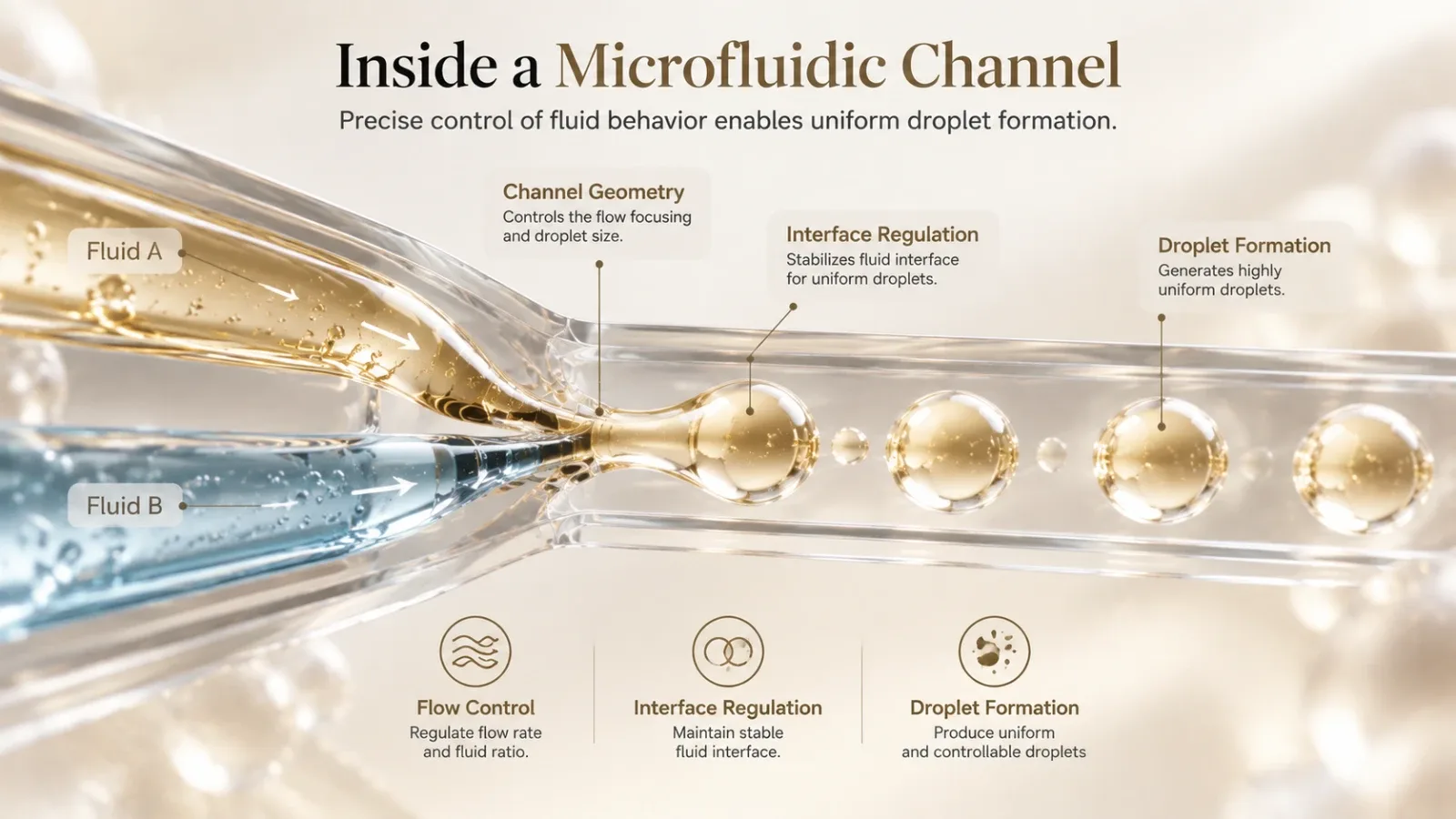
By controlling fluid flow, volume ratio, and interfacial interactions between different phases, microfluidic systems enable the formation of highly controlled droplets.
Compared with conventional fluid processing methods, the key concept of microfluidics lies in two words: “micro” and “control.”
“Micro” refers to the microscale environment where fluid behaviors can be precisely managed.
“Control” represents the ability to regulate fluid movement, interaction, and droplet formation with high accuracy.
Through this precise control, researchers can achieve more consistent droplet generation and subsequently produce microspheres with improved uniformity and structural consistency.
Why Does Microsphere Precision Matter?
In regenerative medicine materials, microspheres are not simply passive particles.
They often serve as important carriers of material properties, and their size, morphology, and surface characteristics can influence how materials are distributed and interact within the tissue environment.
During traditional microsphere manufacturing processes, droplet formation may be affected by multiple variables, including fluid dynamics, shear forces, and interfacial changes.
As a result, variations in particle size and morphology may occur.
For regenerative aesthetic solutions, improving microsphere consistency provides a more controlled foundation for material design.
Therefore, advanced microsphere manufacturing is not only about creating microspheres, but also about precisely controlling:
Particle size.
Particle morphology.
Manufacturing consistency.

How Does Microfluidic Technology Enable Precision Microsphere Manufacturing?
The core advantage of microfluidic technology lies in its ability to regulate multiphase fluid behavior at the microscale.
When different fluids enter a microfluidic chip, the system controls flow conditions, fluid ratios, and channel structures to generate highly uniform droplets.
These droplets can then be processed into microspheres with more consistent size and morphology.
The process can be summarized as:
Precise fluid control
→ Uniform droplet formation
→ Controlled microsphere structure
→ More consistent biomaterial systems
This approach allows microsphere production to move from process-dependent manufacturing toward a more precise and reproducible engineering model.

The Role of Microfluidic Technology in Regenerative Aesthetics
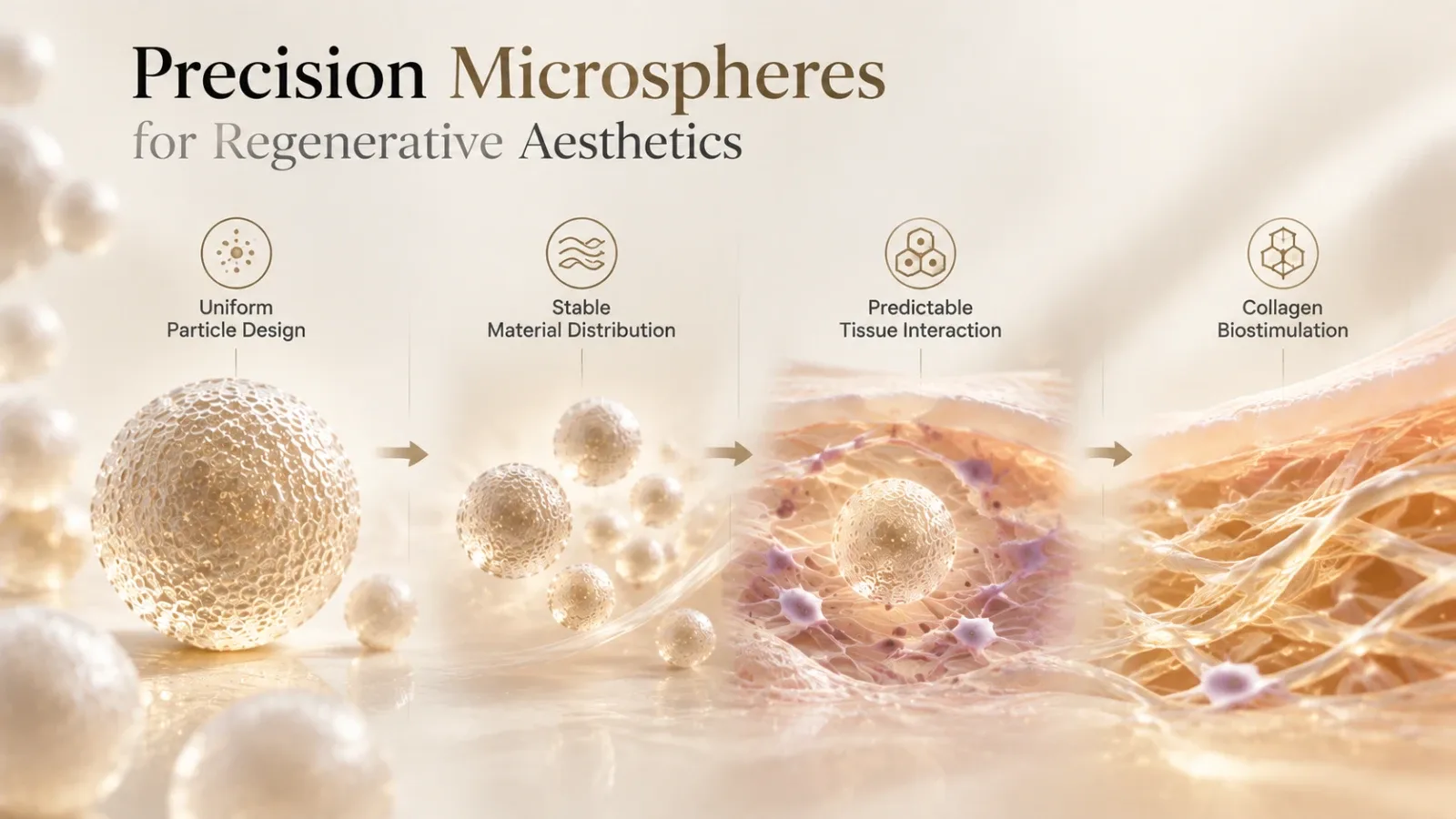
For collagen-stimulating materials, microspheres are not only structural components but also important elements that influence material–tissue interaction.
Therefore, microsphere uniformity, morphology, and manufacturing consistency are critical considerations during product development.
Taking PLLA microspheres as an example, precise microsphere engineering helps establish a more controlled material foundation for regenerative applications.
Through advanced manufacturing technologies, developers can better manage:
Particle consistency.
Material distribution.
Product design stability.
This is why the future of regenerative aesthetics is not only about selecting advanced materials, but also about developing advanced ways to manufacture and engineer those materials.
From Microfluidic Technology to Soul Youth Regenerative Solutions
A complete regenerative aesthetic solution requires more than a single biomaterial.
It requires the integration of material selection, microsphere engineering, and formulation design.
Soul Youth REVIVE combines PLLA, HA, and Trehalose as a comprehensive formulation strategy.
PLLA microspheres serve as the core biostimulatory component, supporting a gradual collagen remodeling process through sustained material–tissue interaction.
HA provides early volume and hydration support, while Trehalose contributes to the overall formulation design.
Within this system, microsphere engineering becomes an important connection between biomaterial science and final product performance.
From precise microsphere manufacturing to regenerative tissue support, each stage contributes to the development of modern aesthetic solutions.

Precision Manufacturing, Advancing the Future of Regenerative Aesthetics
The value of microfluidic technology goes beyond improving manufacturing efficiency.
More importantly, it enables biomaterial production to become more precise, controlled, and reproducible.
From microscopic droplets to engineered microspheres;
From material design to tissue applications;
Microfluidic technology is helping shape the next generation of regenerative aesthetic solutions.
The future of regenerative aesthetics is not only about discovering new materials.
It is about designing, manufacturing, and applying those materials with greater precision.
Specifications, terms and registration status.
Our team supports licensed clinics, distributors and OEM partners — tell us what your market needs.