8 August 2026
Beyond Hydration: The Scientific Rationale for PDRN + HA Skin Boosters
Hydration is an essential part of skin quality, but hydration alone does not describe every process involved in tissue recovery. This is the central rationale behind combining PDRN and hyaluronic acid in one injectable skin booster.
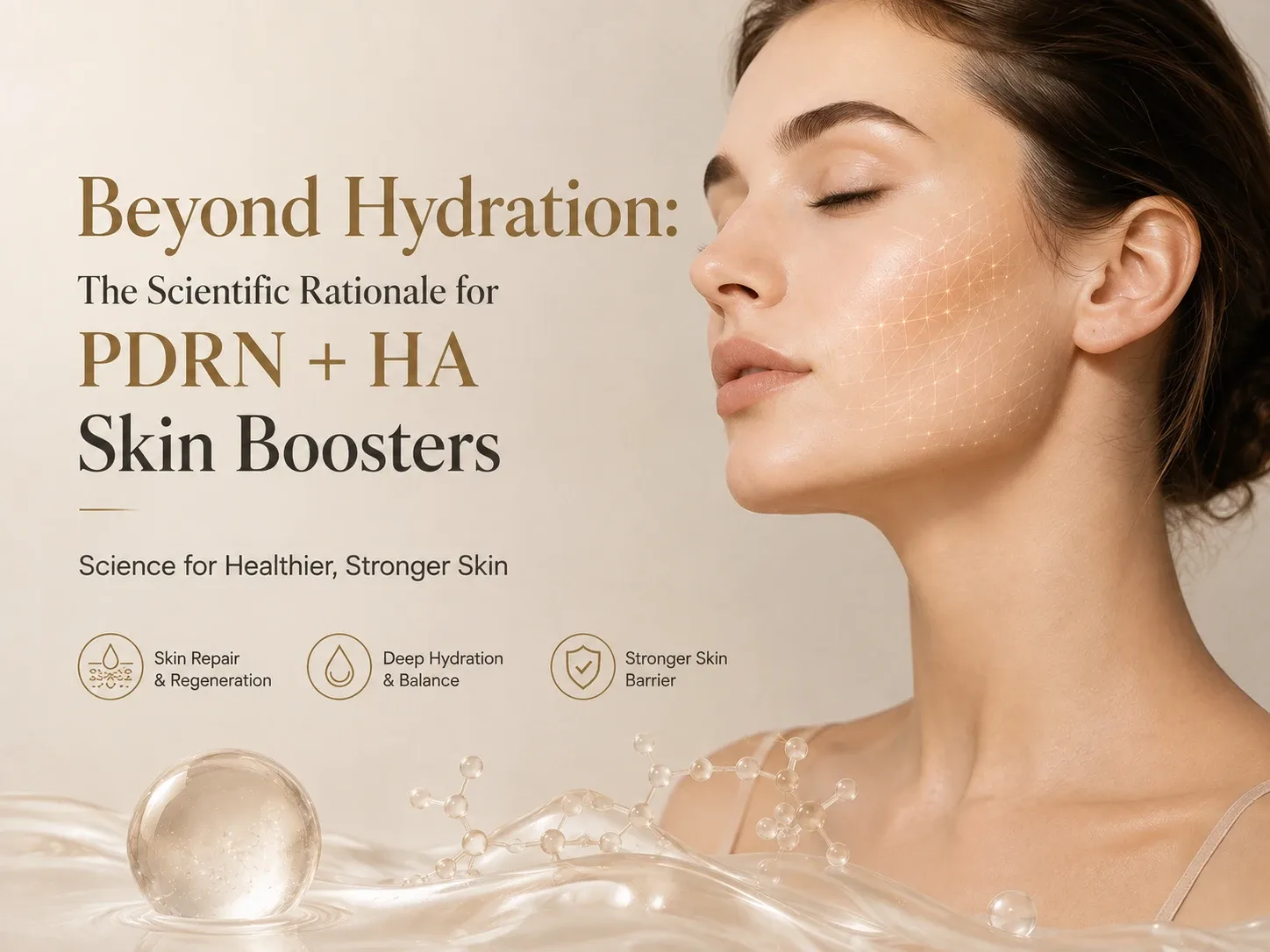
PDRN is a DNA-derived polynucleotide studied for its role in tissue-repair signalling; hyaluronic acid contributes hydration. Combined in one skin booster, the formulation is positioned for skin quality rather than volume — which is why it is evaluated differently from a filler.
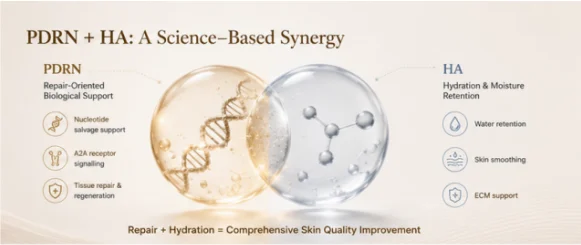
HA primarily contributes water retention and skin smoothness. PDRN is studied for its relationship with nucleotide salvage, adenosine A2A receptor signalling and tissue-repair pathways. Together, the two ingredients create a formulation concept that extends beyond hydration-only skin boosters.
Soul Youth REPAIR is formulated as a professional PDRN + HA injectable skin booster.
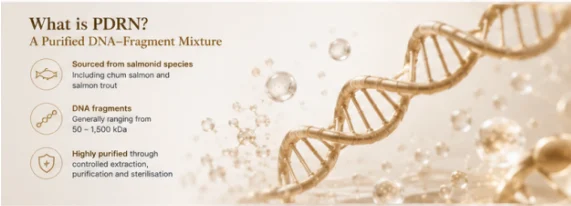
PDRN is a purified DNA-fragment mixture
PDRN stands for polydeoxyribonucleotide. Traditional pharmaceutical PDRN is produced through controlled extraction, purification and sterilisation of DNA obtained from salmonid sources, including chum salmon and salmon trout.
Published pharmacological reviews describe PDRN as a mixture of DNA fragments generally ranging from approximately 50 to 1,500 kDa. Its biological activity has been studied primarily in wound healing, tissue repair, vascular recovery and inflammatory models.
The term salmon-derived PDRN accurately describes its origin. However, statements such as “90% homologous to the human extracellular matrix” are scientifically inappropriate: DNA fragments cannot be directly compared with the extracellular matrix in that way.
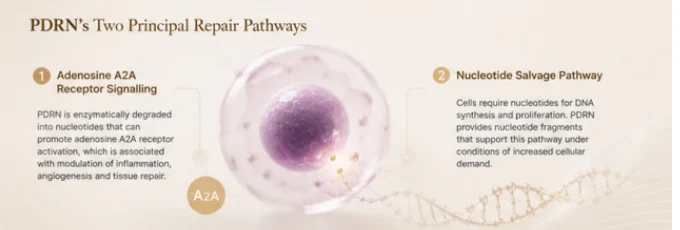
The two principal repair pathways associated with PDRN
PDRN’s proposed biological activity is commonly explained through two complementary mechanisms.
The first is adenosine A2A receptor signalling. Enzymatic degradation of PDRN produces nucleotides and nucleosides that can contribute to adenosine-mediated signalling. Activation of A2A receptors has been associated in experimental models with modulation of inflammatory mediators, angiogenesis and tissue repair.
The second is the nucleotide salvage pathway. Cells involved in tissue repair require nucleotides for DNA synthesis and proliferation. Providing nucleotide fragments may support this metabolic pathway under conditions where cellular demand is increased.
Reviews of PDRN research report effects involving cell migration, fibroblast activity, angiogenesis and inflammatory modulation. Most of this evidence comes from pharmaceutical, wound-healing, preclinical or non-aesthetic indications, so it supports the biological rationale but should not be presented as direct proof of a specific cosmetic result for every injectable PDRN formulation.
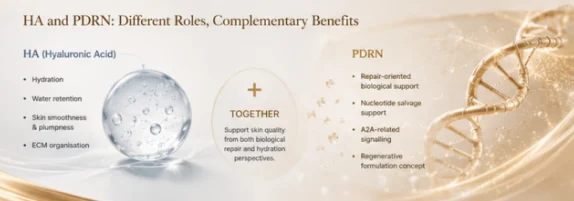
HA and PDRN answer different skin-quality needs
Hyaluronic acid is a glycosaminoglycan naturally present in human tissues. Its ability to bind water makes it important for hydration, lubrication and extracellular-matrix organisation. In a skin booster, HA is commonly used to improve moisture retention and the appearance of smoothness and plumpness.
The formulation logic can therefore be expressed clearly:
PDRN
Repair-oriented biological support
Nucleotide salvage support
A2A-related signalling
Regenerative formulation concept
Hyaluronic acid
Hydration and moisture retention
Smoother skin appearance
Hydrated tissue environment
Immediate water-binding function
This does not mean HA “cannot” participate in repair or that PDRN treats all inflammation and aging. HA itself has roles within tissue repair and cell signalling, while the strength of PDRN evidence varies by indication. The more defensible positioning is:
PDRN + HA combines repair-oriented biological support with established hydration functionality.
A broader definition of skin boosting
A hydration-only booster is designed primarily around water retention. A regenerative skin booster aims to support a broader skin-quality environment.
The rationale for combining PDRN and HA is therefore not that one ingredient replaces the other. Their roles are complementary: HA supports hydration, while PDRN adds a repair-oriented nucleotide platform.
That combined logic supports the positioning of Soul Youth REPAIR as a PDRN + HA skin booster designed around skin quality, hydration and professional regenerative-aesthetic care.
Explore Soul Youth REPAIR PDRN + HA Skin Booster
For product documentation, wholesale supply or distribution cooperation:
References
Specifications, terms and registration status.
Our team supports licensed clinics, distributors and OEM partners — tell us what your market needs.