25 September 2026
PLLA vs PDLLA: From Stereochemistry and Degradation Kinetics to Formulation Design — What Should We Really Compare in Poly-Lactic Acid Biostimulators?
In regenerative aesthetics, PLLA and PDLLA are frequently discussed within the same framework. Both belong to the poly-lactic acid family and can be used in collagen-biostimulating products, which is why market discussions often reduce the comparison to a simple question: which one is better?
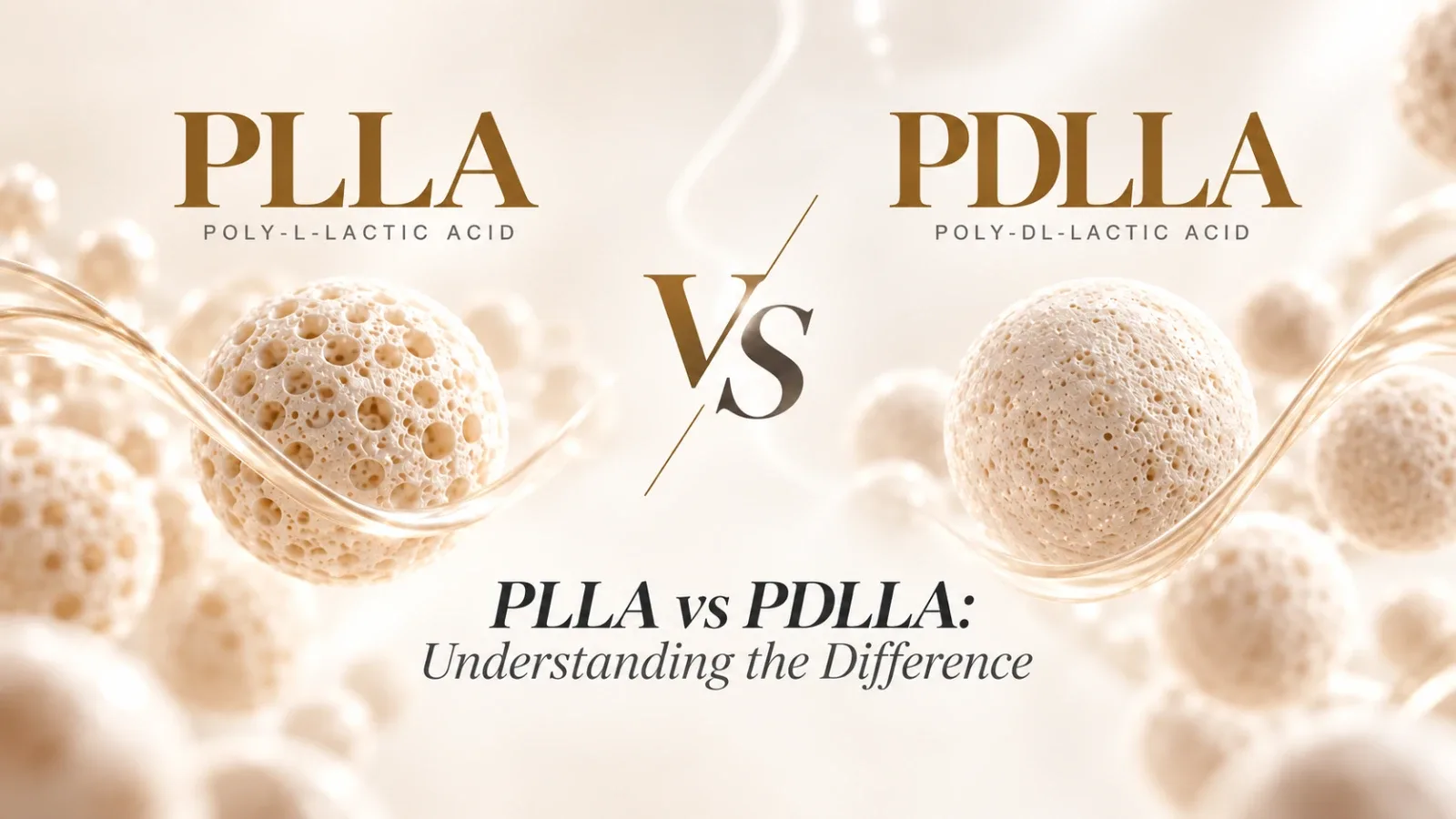
From the perspective of biomaterial science and product design, however, that question is too simplistic.
The meaningful difference between PLLA and PDLLA is not merely a matter of superiority. It lies in how stereochemical structure influences polymer crystallinity, how crystallinity subsequently affects hydrolysis and molecular-weight reduction, and how those material kinetics shape residence time, tissue exposure, cellular response, and ultimately collagen remodeling.
In other words, the focus should shift from material names to material behavior.
1. The Difference Begins with Stereochemistry, Not Degradation Speed
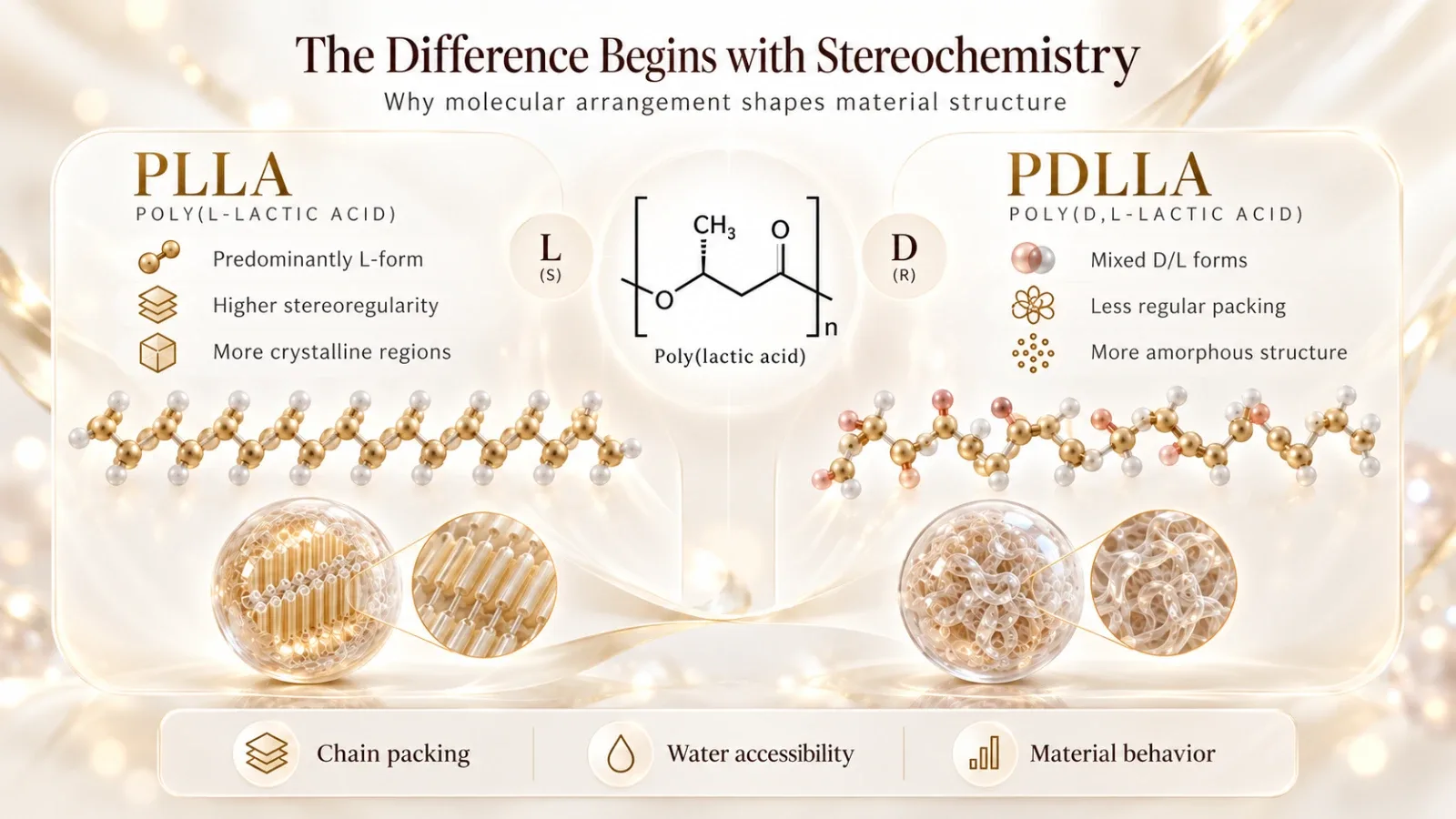
Lactic acid exists in different chiral configurations, most notably L-lactic acid and D-lactic acid. Once polymerized, the spatial configuration of these monomers influences how regularly the polymer chains can pack.
PLLA is mainly composed of L-lactic acid units and therefore has greater stereoregularity, allowing portions of the polymer to form crystalline regions. PDLLA contains both D- and L-lactic acid units, and the random distribution of these configurations disrupts regular chain packing, resulting in a more amorphous material overall.
The significance of this difference lies in the fact that crystalline and amorphous regions do not interact with water or molecular motion in the same way. Amorphous regions are less tightly packed and more accessible to water, while crystalline regions are more densely organized and generally more resistant to water penetration and hydrolysis.
The difference in degradation between PLLA and PDLLA is therefore not an isolated parameter. It is the downstream result of stereochemistry, crystallinity, and polymer microstructure.
2. Poly-Lactic Acid Degradation Is Not a Sudden Disappearance but a Continuous Kinetic Process
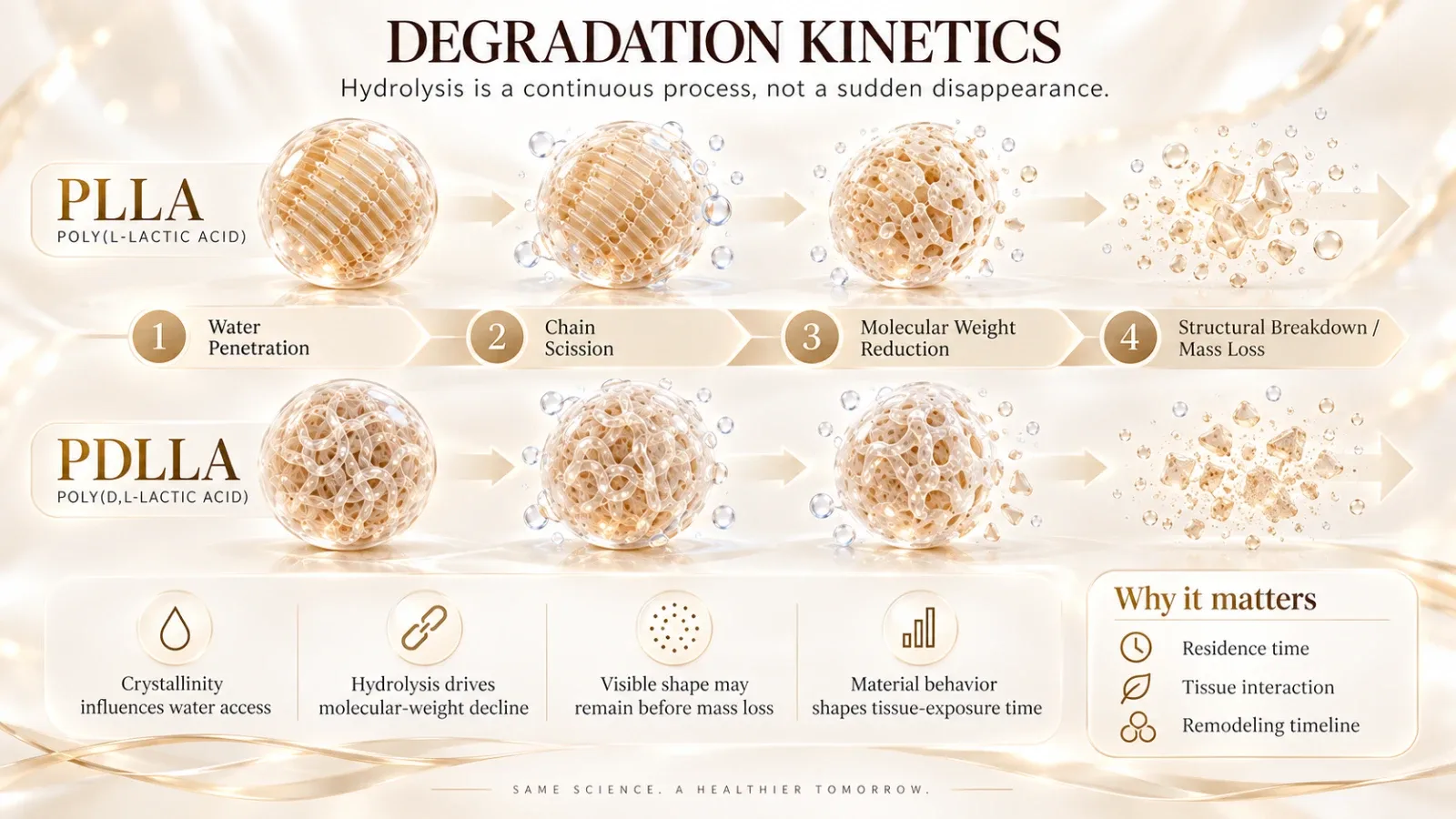
Poly-lactic acid materials degrade primarily through hydrolysis of ester bonds.
During the early stage, water penetrates the polymer and begins cleaving polymer chains. Molecular weight may fall before the particle visibly loses its overall form. As chain scission continues, mechanical integrity decreases and more obvious mass loss follows.
This means that simply asking whether the material is “still present” does not adequately describe its degradation state.
For a collagen biostimulator, the more relevant questions are what surface characteristics, molecular-weight profile, and tissue-exposure pattern the material presents at each stage, because these collectively determine the environment encountered by surrounding cells.
The statement that PLLA generally degrades more slowly is therefore important not because “longer is automatically better,” but because it may create a more prolonged and gradual window of material–tissue interaction.
3. Why Do Crystallinity and Degradation Kinetics Matter for Tissue Response?
Collagen biostimulators do not rely solely on the polymer itself to create volume. Their biological effect depends on the interaction that develops after the material is introduced into tissue.
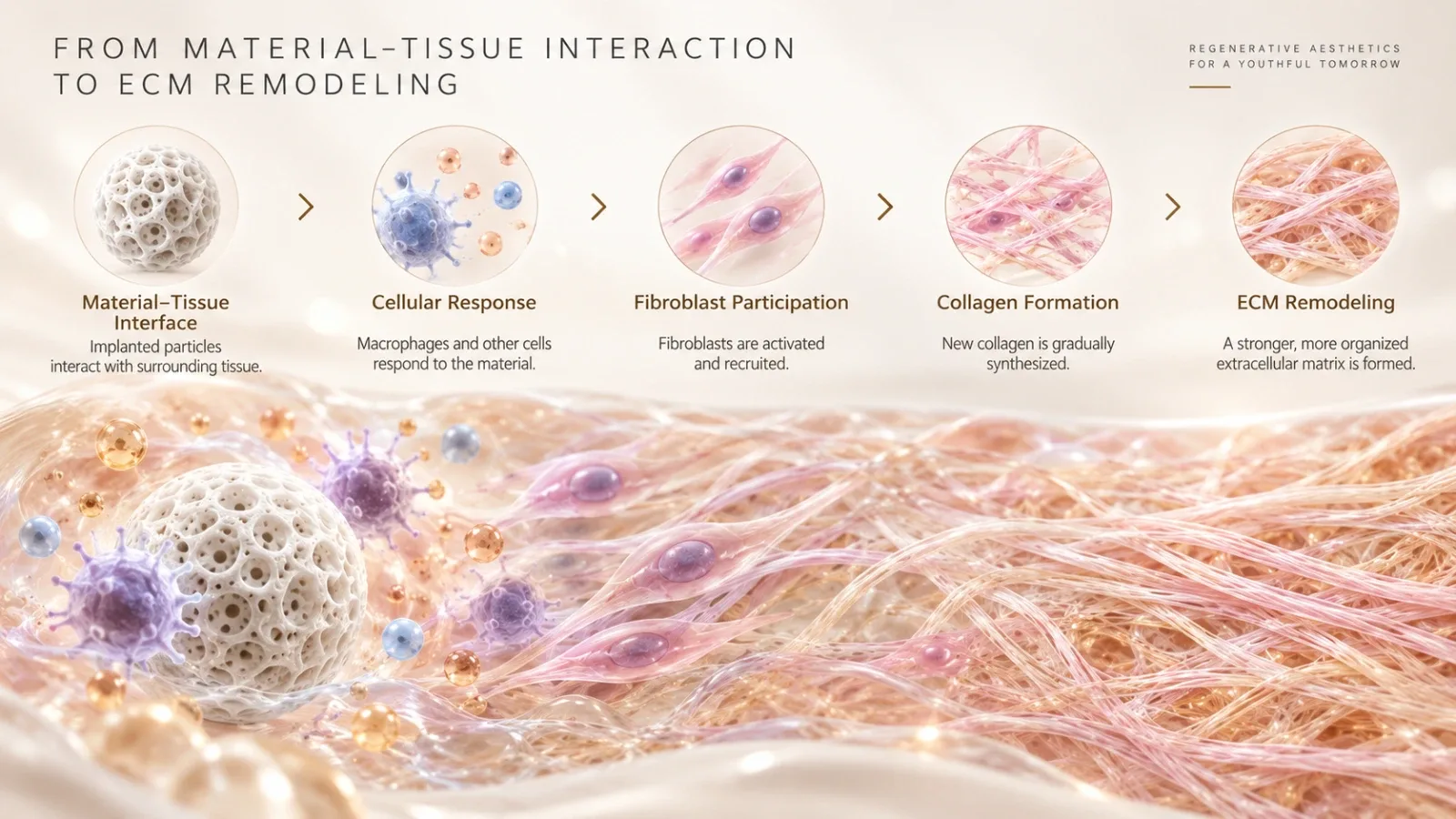
Particles create a local material–tissue interface. As the material persists and gradually changes, surrounding cells respond to that interface, including macrophage activity, fibroblast participation, and processes associated with extracellular matrix remodeling.
For PLLA, a more sustained material presence can create a longer time scale for tissue interaction. During this process, fibroblast participation may increase, new collagen can gradually form, and the extracellular matrix can subsequently undergo remodeling.
However, the final biological response is not determined by the word “PLLA” alone.
Molecular weight, particle size, particle-size distribution, surface morphology, concentration, suspension characteristics, and injection plane can all alter effective surface area, local material density, and tissue contact. Two products that both contain PLLA should therefore not automatically be assumed to behave identically.
This is why a comparison that stops at “PLLA versus PDLLA” is still incomplete.
The more appropriate unit of evaluation is the complete formulation system.
4. Material Selection Should Begin with the Intended Objective
If the objective is primarily short-term space occupation and volume restoration, immediate physical support may be one of the most important design parameters.
If the objective is to create a gradual collagen-biostimulation process, material residence time, degradation kinetics, and tissue-interaction profile become more important.
If the objective is to combine early visible support with later tissue remodeling, product design must address two different time scales.
In the early stage, patients may benefit from volume and hydration support. Over the following months, the formulation may need to continue participating in collagen formation and ECM remodeling through a biostimulatory pathway.
The real design question is therefore not simply whether to choose PLLA or PDLLA.
It is how to build a material system in which each component serves the intended objective at the appropriate time.
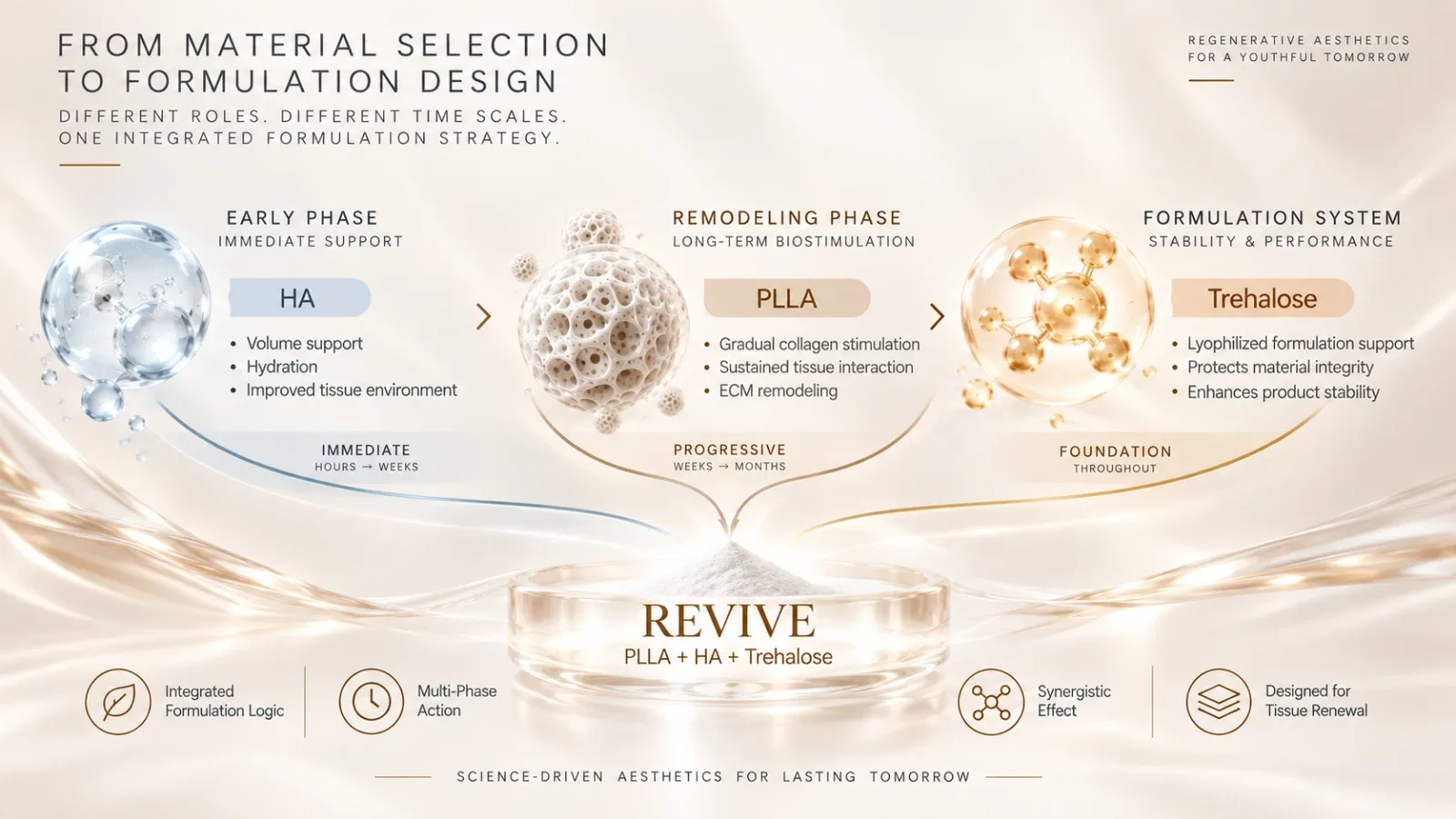
5. Why Does REVIVE Combine PLLA + HA + Trehalose?
The formulation logic of Soul Youth REVIVE™ is built around this time-dependent division of roles.
HA addresses the earlier stage by providing volume and hydration support. This means that the solution does not rely entirely on later collagen remodeling before structural changes can become apparent.
PLLA operates on a longer time scale. After PLLA microspheres are introduced into tissue, sustained material–tissue interaction creates a gradual biological response, followed by increased fibroblast participation, progressive collagen formation, and subsequent extracellular matrix remodeling.
Trehalose does not function as an independent filling or collagen-stimulating module. Instead, it serves as part of the lyophilized formulation system and contributes to the overall product-design strategy.
The concept of REVIVE is therefore not simply to place three ingredients into the same formulation.
Each component is assigned a different role across a different time scale.
HA supports the early phase, PLLA supports gradual collagen biostimulation and tissue remodeling, and Trehalose contributes to the formulation system itself.
This design logic moves beyond the question of “PLLA or PDLLA” and toward the more meaningful question of how a complete product should solve a biological problem.
6. Moving from Material Names to Material Systems
The next stage of regenerative aesthetics should not focus only on individual “trending materials,” but on material systems.
A complete collagen-biostimulating solution needs to answer several questions at the same time: why the material was selected, how it changes after implantation, whether its degradation profile is aligned with the intended remodeling timeline, how it interacts with other formulation components, and how these factors are ultimately translated into tissue-level outcomes.
The difference between PLLA and PDLLA provides a useful material-science starting point for answering these questions.
But the true value of a product depends on how molecular structure, particle design, degradation kinetics, formulation strategy, and tissue objectives are integrated into one system.
This is why understanding PLLA and PDLLA should not lead to a simplistic conclusion about which material is superior.
Instead, it should lead to a more precise logic of material selection.
For Soul Youth, selecting a PLLA-based pathway for REVIVE™ and combining it with HA and Trehalose reflects the need to address both immediate support and gradual tissue remodeling across different time scales.
The material is not the endpoint.
How the material is designed into a solution is what matters.
Conclusion
The difference between PLLA and PDLLA begins with stereochemistry, but it does not end there. Molecular arrangement influences crystallinity, crystallinity influences hydrolysis and material kinetics, and material kinetics shape the time window over which tissue interaction occurs.
A meaningful comparison therefore should not stop at asking which material degrades faster.
It should ask whether the degradation profile is aligned with the intended tissue response, whether the material can be integrated effectively with other components, and whether the final formulation translates biomaterial science into a clear treatment logic.
From this perspective, comparing PLLA and PDLLA is only the starting point.
What ultimately needs to be designed is the entire regenerative process.
Specifications, terms and registration status.
Our team supports licensed clinics, distributors and OEM partners — tell us what your market needs.