12 October 2026
PN vs. PDRN: Understanding the Science Behind DNA-Derived Biomaterials
Molecular Structure, Biological Mechanisms, Formulation Science, and Clinical Evidence in Regenerative Aesthetics The growing interest in regenerative aesthetics has brought DNA-derived biomaterials into the spotlight. Among the most frequently discussed are polynucleotides (PN) and polydeoxyribonucleotides (PDRN).
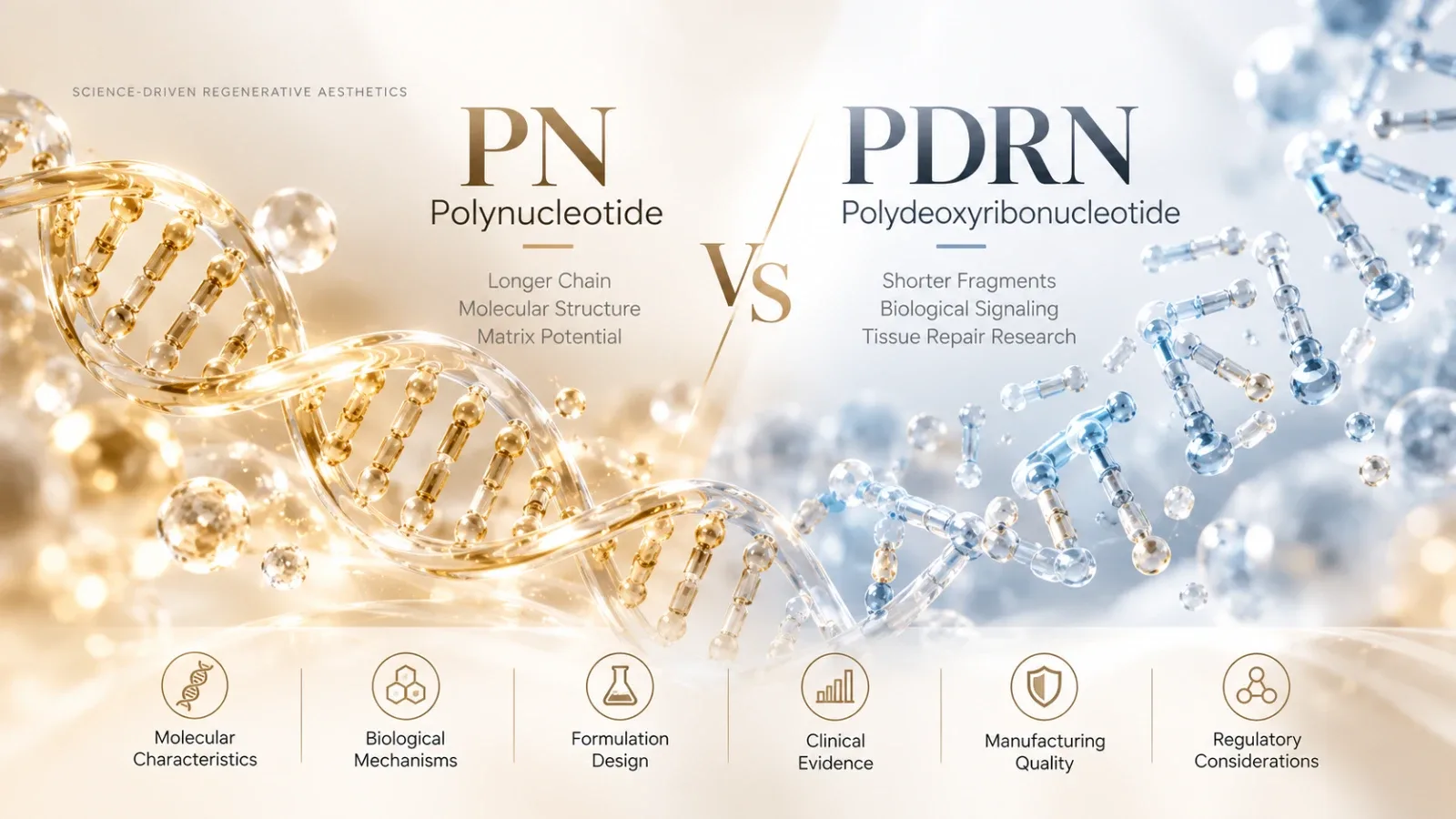
They have attracted attention in dermatology, tissue repair, and skin-quality improvement. Although their names are often used to distinguish different product categories, the scientific relationship between PN and PDRN is more complex than a simple comparison suggests.
Understanding their differences requires looking beyond commercial terminology and examining molecular characteristics, biological mechanisms, formulation design, and clinical research.
1. What Are PN and PDRN?
Polynucleotides (PN)
In general biochemistry, a polynucleotide is a polymer composed of nucleotide units, encompassing a broad family of nucleic acids.
Within aesthetic medicine, PN commonly refers to purified, relatively long-chain DNA-derived polymers used in certain injectable formulations.
These materials are studied for their physical properties, including polymeric behavior, hydration interactions, and potential contributions to the local tissue environment.
Polydeoxyribonucleotides (PDRN)
PDRN refers to preparations containing deoxyribonucleotide polymers or DNA fragments.
In biomedical research, PDRN has been investigated for biological activities associated with tissue repair, inflammation-related signaling, and nucleotide metabolism.
PDRN preparations are often described as having shorter DNA fragments than higher-molecular-weight PN formulations.
However, PN and PDRN do not have universally standardized, mutually exclusive definitions across all scientific publications and commercial products.
Their molecular-weight ranges may overlap depending on the manufacturer and analytical methods used.
2. PN vs. PDRN: Understanding Molecular Weight and Chain Length
Molecular weight is one of the most commonly discussed differences between PN and PDRN.
In general, PN formulations are associated with longer DNA chains, while PDRN preparations are often characterized by shorter fragments.
Longer polymer chains may contribute to different rheological and physical properties compared with shorter fragments.
These differences can influence formulation design, including viscosity, molecular interactions, and the behavior of the material in solution.
Is There a Standard Molecular-Weight Cutoff?
There is currently no universally adopted regulatory threshold separating PN from PDRN.
Some researchers have proposed using 1,500 kDa as a classification boundary, with lower-molecular-weight preparations described as PDRN and higher-molecular-weight materials categorized as PN.
However, this is a proposed scientific classification rather than an internationally harmonized standard.
For accurate comparison, molecular-weight distribution data are more informative than product labels alone.
3. How Do PN and PDRN Differ in Physical Properties?
Molecular chain length can influence the physical behavior of nucleotide-based formulations.
PN: Longer-Chain Polymeric Characteristics
Higher-molecular-weight PN may exhibit polymeric properties that contribute to formulation viscosity and viscoelasticity.
Depending on molecular-weight distribution, concentration, and formulation composition, these materials may display cohesive or network-like behavior.
Such properties are relevant to the development of certain injectable biomaterial formulations.
PDRN: DNA Fragments and Solution-Based Formulations
PDRN preparations are frequently investigated for biological mechanisms involving DNA-derived fragments and their metabolites.
Compared with longer-chain PN systems, certain PDRN preparations may exhibit different solution properties and formulation requirements.
However, molecular weight alone does not determine viscosity, injectability, tissue persistence, or clinical performance.
These characteristics must be evaluated in the context of the complete formulation.
4. PDRN Mechanism of Action: What Does Research Suggest?
Two biological mechanisms are frequently discussed in the scientific literature on PDRN.
Adenosine A2A Receptor-Related Signaling
Experimental studies have associated certain PDRN preparations with biological effects involving the adenosine A2A receptor pathway.
A2A signaling participates in several physiological processes, including the regulation of inflammatory responses and aspects of tissue repair.
Preclinical studies have explored the relationship between PDRN administration and cellular responses associated with healing.
However, the precise relationship between intact DNA fragments, their breakdown products, and receptor activation requires careful interpretation.
Evidence obtained with one PDRN preparation should not automatically be generalized to all products marketed under the same ingredient name.
Nucleotide Salvage Pathway
Another proposed mechanism involves the nucleotide salvage pathway.
This metabolic pathway allows cells to reuse nucleosides and nucleotide bases to support nucleic acid synthesis.
DNA-derived fragments may provide substrates that become available through biological processing.
This mechanism offers a rationale for investigating PDRN in tissue-repair research.
Nevertheless, mechanistic plausibility does not independently establish clinical efficacy for a particular aesthetic indication.
5. PN and PDRN in Skin Rejuvenation
PN and PDRN have been investigated in several dermatological and aesthetic applications, including skin texture, fine lines, wound healing, and post-procedural recovery.
Published studies have reported encouraging findings in selected settings.
However, the overall evidence remains heterogeneous.
Differences in product composition, injection protocols, treatment intervals, participant populations, and clinical endpoints make direct comparisons difficult.
Some studies evaluate PN, others investigate PDRN, and still others use combination formulations.
Consequently, findings from one formulation cannot automatically be applied to another.
Is PN Better Than PDRN?
Current evidence does not establish that PN is universally superior to PDRN, or vice versa.
Clinical performance depends on the actual formulation, intended use, administration protocol, and supporting evidence.
Well-designed, adequately powered head-to-head clinical trials are needed to clarify whether specific PN and PDRN formulations produce meaningfully different outcomes.
6. Why Formulation Science Matters More Than Ingredient Labels
A product's performance cannot be determined by its headline ingredient alone.
Two formulations containing the same stated concentration of PDRN may differ substantially in physical and biological characteristics.
Important variables include:
Molecular-weight distribution and chain length
DNA concentration and purity
Residual proteins and process-related impurities
Formulation pH and osmolality
Sterility, endotoxin control, and stability
Additional ingredients and carrier composition
Intended administration route and use conditions
These factors are essential considerations in developing and evaluating nucleotide-based biomaterials.
PDRN Combined With Hyaluronic Acid
Hyaluronic acid (HA) is a naturally occurring glycosaminoglycan widely studied for its water-binding properties and role in extracellular matrix biology.
Combining PDRN with HA represents one approach to developing multifunctional aesthetic formulations.
The scientific rationale is based on bringing together materials with different physical and biological characteristics.
HA may contribute to hydration and formulation rheology, while PDRN is investigated for potential biological activities associated with tissue repair.
However, the presence of both ingredients does not automatically establish synergistic efficacy.
Any claim of improved outcomes requires studies of the specific combination formulation.
7. Manufacturing and Purification: From DNA Source to Finished Product
PN and PDRN are commonly produced using purified DNA from biological sources, including salmonid fish.
The source material alone does not determine the quality of the finished ingredient.
Manufacturing processes may include DNA extraction, purification, molecular-weight adjustment or fractionation, and analytical characterization.
For injectable products, manufacturing controls must also address relevant microbiological and physicochemical quality requirements.
Key Quality Considerations
Identity and molecular characterization
Confirming the composition and molecular-weight distribution of the DNA-derived material.
Purity
Assessing residual proteins, nucleic acid-related impurities, and other process-related substances.
Microbiological quality
Establishing appropriate sterility and endotoxin controls for the intended product.
Formulation stability
Evaluating whether the material maintains its intended characteristics during storage.
Batch consistency
Demonstrating reproducible material and formulation properties across manufacturing batches.
These considerations are particularly important because broad ingredient labels may conceal substantial differences between individual preparations.
8. PN vs. PDRN: Key Differences at a Glance
CharacteristicPNPDRNCommon meaning in aestheticsRelatively long-chain DNA-derived polymersPreparations of DNA-derived fragmentsTypical molecular weightGenerally higherGenerally lowerUniversal molecular-weight cutoffNot establishedNot establishedFormulation characteristicsMay exhibit more pronounced polymeric and viscoelastic behaviorOften investigated in solution-based biological formulationsMechanistic researchPhysical and biological properties under investigationA2A-related signaling and nucleotide salvage pathwaysClinical applications studiedSkin-quality improvement and selected dermatological applicationsTissue repair, wound healing, and selected aesthetic applicationsMain considerationMolecular characterization and formulation-specific evidenceMolecular characterization and formulation-specific evidence
This table summarizes common scientific distinctions rather than universally applicable specifications.
9. Frequently Asked Questions
Are PN and PDRN the Same Ingredient?
They are related categories of DNA-derived biomaterials, but they are not necessarily identical preparations.
Their differences are often associated with molecular chain length and molecular-weight distribution. Terminology varies across products and publications.
Is PN Always Higher in Molecular Weight Than PDRN?
Generally, PN is associated with longer DNA chains, but this is not an absolute rule.
Without standardized analytical data, molecular-weight differences cannot be confirmed from the product name alone.
Does PDRN Stimulate Collagen Production?
Certain experimental studies have explored biological responses associated with PDRN, including pathways relevant to tissue repair.
However, a generalized claim of increased collagen production cannot be applied to every PDRN formulation without appropriate evidence.
Can PDRN Be Combined With Hyaluronic Acid?
Yes. PDRN and HA may be incorporated into combination formulations.
Their compatibility, stability, physical properties, and clinical performance must be assessed for the specific formulation.
Which Is Better for Skin Rejuvenation: PN or PDRN?
There is no universal answer.
The appropriate evaluation depends on product composition, molecular characteristics, clinical evidence, regulatory authorization, and intended use.
10. The Soul Youth Perspective: Beyond Ingredient Terminology
At Soul Youth, we believe meaningful progress in regenerative aesthetics requires a deeper understanding of biomaterial science.
The discussion surrounding PN and PDRN highlights the importance of looking beyond ingredient names.
Molecular-weight distribution, purification, formulation engineering, manufacturing consistency, and clinical validation all contribute to the development of scientifically characterized products.
Our interest in PDRN-based biomaterials and combination formulation strategies reflects this broader scientific perspective.
Rather than viewing PN and PDRN as competing marketing categories, we see them as related areas of biomaterial research that deserve careful scientific evaluation.
The future of regenerative aesthetics will be shaped not simply by new ingredient names, but by better material characterization, more rigorous evidence, and responsible product innovation.
Soul Youth | Science-Driven Regenerative Aesthetics
References and Further Reading
From Polydeoxyribonucleotides (PDRNs) to Polynucleotides (PNs). International Journal of Molecular Sciences, 2025. https://pmc.ncbi.nlm.nih.gov/articles/PMC11764130/
Comparison of Polynucleotide and Polydeoxyribonucleotide in Dermatology. Pharmaceutics, 2025. https://pmc.ncbi.nlm.nih.gov/articles/PMC12388916/
Pharmacological Activity and Clinical Use of PDRN. Frontiers in Pharmacology, 2017. https://pubmed.ncbi.nlm.nih.gov/28491036/
Disclaimer: This article is intended for scientific and professional education. The information does not constitute medical advice or establish the safety, efficacy, regulatory approval, or intended use of any specific product. Product availability and clinical use are subject to applicable regulatory requirements.
Specifications, terms and registration status.
Our team supports licensed clinics, distributors and OEM partners — tell us what your market needs.