1 July 2026
Regenerative Aesthetics: The Science Behind Modern Aesthetic Medicine
Aesthetic medicine is evolving. For many years, facial rejuvenation was primarily approached through volume replacement, wrinkle correction and structural enhancement. Today, a broader concept is gaining attention: regenerative aesthetics.

Rather than focusing only on what is added to the face, regenerative aesthetics asks a different question:
How can aesthetic treatments support the biological processes of aging tissue?
This shift has brought greater attention to collagen stimulation, extracellular matrix remodeling, tissue quality and biological signaling — creating a new framework for understanding modern regenerative injectables.
What Is Regenerative Aesthetics?
Regenerative aesthetics is an emerging area of aesthetic medicine that applies principles of regenerative medicine to age-related changes in skin and soft tissue.
The concept focuses on supporting the body's biological processes involved in tissue remodeling, collagen production, skin quality and structural integrity.
Unlike conventional approaches that may primarily aim to replace lost volume or correct a visible contour, regenerative aesthetics places greater emphasis on the relationship between biomaterials and tissue response.
Research describing the development of regenerative aesthetics has highlighted the importance of restoring youthful tissue properties, structure and function rather than focusing solely on temporary morphological correction.
This does not mean that traditional fillers, neuromodulators or surgical procedures are being replaced.
Instead, regenerative aesthetics represents an expanding framework in which volume, structure, skin quality and tissue biology can be considered together.
From Volume Replacement to Biological Remodeling
The traditional concept of facial rejuvenation often begins with a visible problem:
Loss of facial volume
Nasolabial folds
Skin laxity
Loss of contour
Fine lines
Changes in facial proportions
The treatment is then selected according to the visible change.
Regenerative aesthetics introduces another layer of consideration:
What has changed biologically within the tissue?
With aging, changes occur across multiple levels of the facial soft tissue environment, including the skin, extracellular matrix, fat compartments and supporting structures.
Consequently, modern regenerative approaches increasingly consider not only immediate correction but also tissue quality, collagen remodeling and biological integration.
A recent review in the Journal of Cosmetic Dermatology describes this transition as a movement from predominantly volumetric correction toward biologically oriented strategies involving tissue quality, extracellular matrix remodeling and functional integration.
This is one of the reasons the term regenerative aesthetics has become increasingly relevant in contemporary aesthetic medicine.
The Biological Foundation of Regenerative Aesthetics
At the center of regenerative aesthetics is the interaction between a treatment material and the surrounding tissue.
The objective is not simply to place a material into tissue.
The more important question is:
How does the tissue respond over time?
Several biological processes are relevant:
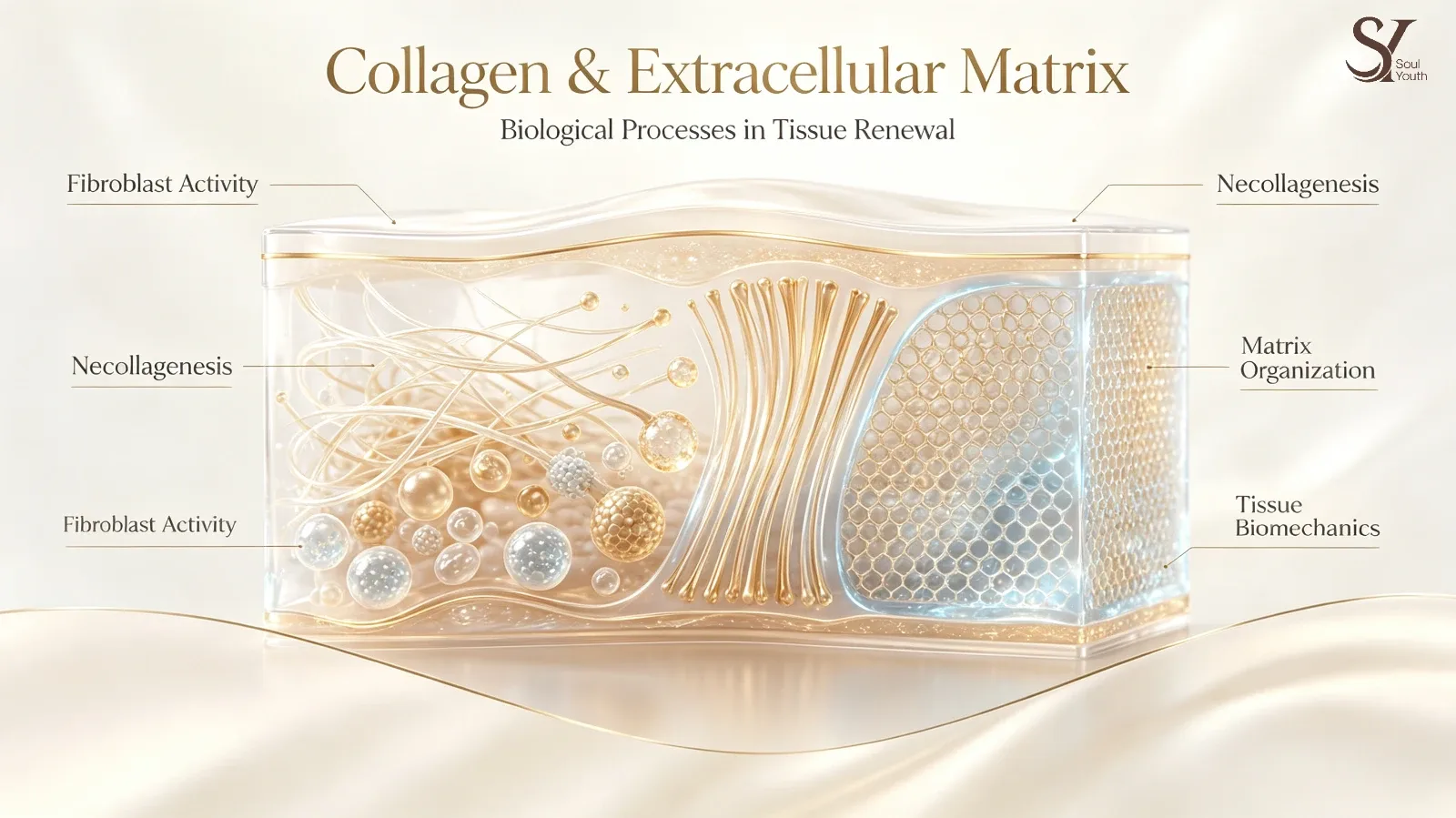
1. Collagen Stimulation
Collagen provides important structural support within the extracellular matrix.
Certain biomaterials can interact with surrounding tissue and stimulate biological responses associated with fibroblast activity and new collagen formation.
This process is commonly referred to as collagen stimulation or neocollagenesis.
Importantly, collagen stimulation should not be understood as directly "injecting collagen" into the skin.
Instead, it refers to supporting biological processes that may contribute to gradual collagen formation and tissue remodeling.
2. Extracellular Matrix Remodeling
The extracellular matrix, or ECM, provides structural and biochemical support for cells.
Changes in the ECM are an important part of tissue aging.
Regenerative approaches therefore increasingly focus on how treatment materials may influence the tissue microenvironment and extracellular matrix remodeling.
3. Tissue Remodeling
Tissue remodeling is a gradual biological process rather than an immediate volumizing effect.
Depending on the biomaterial, treatment and tissue environment, remodeling may involve changes in collagen deposition, matrix organization and tissue biomechanics.
This is particularly relevant to collagen biostimulators such as PLLA and CaHA, which have been studied for their ability to support longer-term tissue remodeling.
Regenerative Injectables: Different Materials, Different Biological Roles
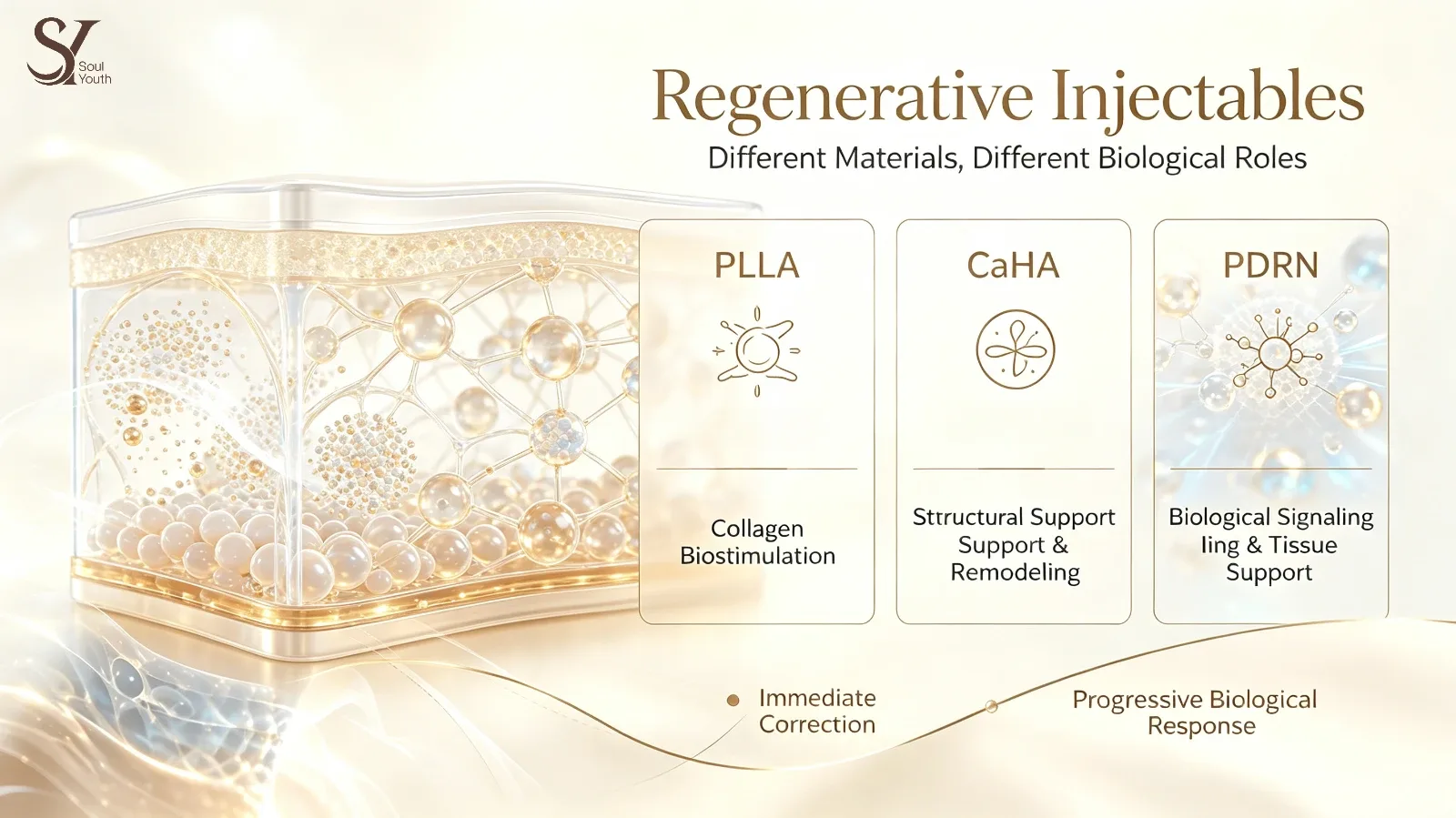
One of the most important points in regenerative aesthetics is that not all regenerative injectables work in the same way.
Different biomaterials interact with tissue through different mechanisms.
PLLA: Collagen Biostimulation
Poly-L-lactic acid, commonly known as PLLA, is one of the best-known particulate collagen biostimulators.
Rather than functioning primarily as an immediate volumizing material, PLLA is associated with a gradual tissue response involving collagen formation and remodeling.
This makes PLLA particularly relevant to the concept of collagen-supported facial rejuvenation.
Soul Youth REVIVE is built around a PLLA microsphere platform combined with HA and trehalose, positioned within Soul Youth's regenerative aesthetic portfolio.
CaHA: Structural Support and Remodeling
Calcium hydroxylapatite (CaHA) is another important biomaterial in regenerative aesthetics.
CaHA can provide immediate structural support while its microsphere component has been studied in relation to collagen stimulation and tissue remodeling.
This creates an interesting combination:
Immediate support + progressive biological response.
CaHA has also been discussed in the literature in relation to regenerative scaffolds and restoration of aging tissue properties.
Soul Youth LIFT uses CaHA microspheres within a PEG-cross-linked HA carrier and is positioned for contour and structural support.
PDRN: A Different Regenerative Perspective
Polynucleotides and polydeoxyribonucleotides are also increasingly discussed within regenerative aesthetics.
Unlike particulate collagen biostimulators, PDRN-based approaches are generally discussed in terms of biological signaling and tissue-support mechanisms rather than primarily as structural scaffolds.
The current scientific literature suggests that biological "bioregulators," including PDRN and related materials, have considerable mechanistic interest, although clinical evidence remains more heterogeneous than for established particulate collagen biostimulators.
This distinction is important.
Regenerative aesthetics is not one material or one treatment.
It is a broader biological framework.
Regenerative Aesthetics vs Traditional Fillers
It is useful to distinguish between immediate correction and biological remodeling.
Traditional Volume-Focused ApproachRegenerative Aesthetic ApproachPrimarily addresses visible volume lossConsiders tissue biology and qualityImmediate morphological correction may be centralGradual biological response may be centralFocus on shape and contourFocus on tissue response and remodelingMaterial provides volume or structural supportMaterial may also stimulate biological processesOutcome can be evaluated primarily by immediate appearanceOutcome may evolve over weeks or months
This does not mean one approach is universally preferable.
Different patients, anatomical conditions and clinical objectives require different strategies.
Instead, the emergence of regenerative aesthetics expands the range of questions that can be considered when planning aesthetic treatment.
Why Collagen Matters in Facial Rejuvenation
Collagen is one of the fundamental structural components of the skin and extracellular matrix.
With chronological aging and environmental exposure, the quantity, organization and mechanical properties of collagen-containing tissue can change.
For aesthetic medicine, this means that rejuvenation is not necessarily only about replacing lost volume.
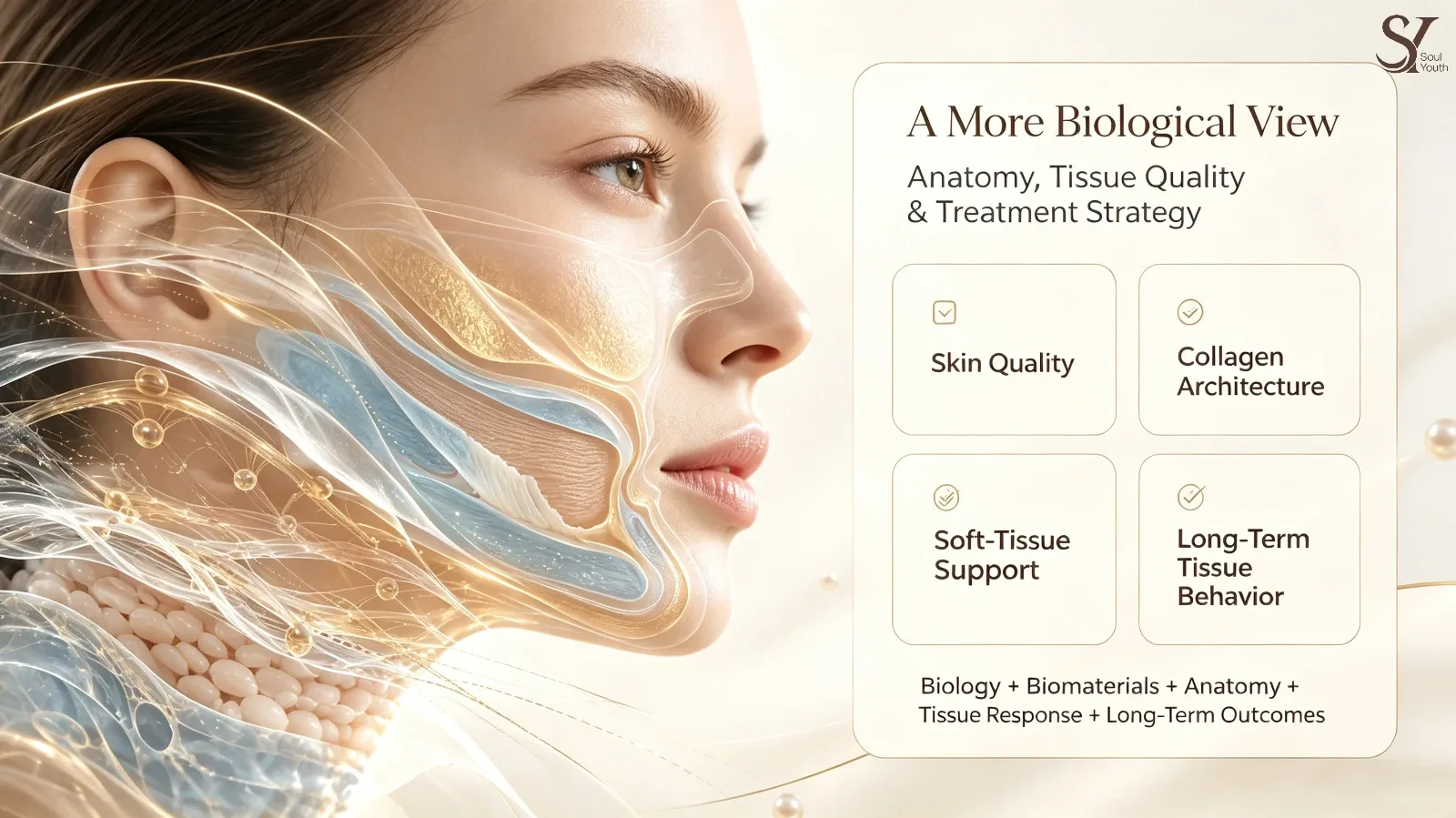
It can also involve considering:
Skin quality
Tissue elasticity
Collagen organization
Extracellular matrix structure
Soft-tissue support
Facial proportions
Long-term tissue behavior
This is why collagen biostimulation has become an important concept within regenerative aesthetics.
The objective is not simply to create an immediate visual change.
It is to understand how the tissue may respond over time.
The Importance of a Multi-Layer Approach
The face is not a single layer.
Facial aging involves interactions between:
Skin
Dermis
Subcutaneous tissue
Fat compartments
Ligaments
Muscles
Bone
Extracellular matrix
A regenerative aesthetic approach therefore benefits from looking beyond individual wrinkles or isolated facial lines.
For example, a visible nasolabial fold may reflect changes in several anatomical structures rather than simply a lack of volume directly underneath the fold.
Similarly, facial laxity may involve changes in skin quality, collagen architecture, soft-tissue support and volume distribution.
This is why contemporary regenerative aesthetic thinking increasingly emphasizes anatomy, tissue quality and treatment sequencing rather than simply treating every visible line independently.
From Individual Products to Regenerative Treatment Strategies
Another important development is the movement from thinking about aesthetic injectables as isolated products toward thinking about treatment strategies.
Different materials may have different roles.
For example:
PLLA → collagen-supported renewal
PDRN + HA → skin quality and hydration support
CaHA → contour and structural support
These roles are not interchangeable.
Instead, they represent different biological and structural objectives within a broader regenerative aesthetic framework.
Soul Youth's portfolio follows this multi-platform concept through three regenerative injectable categories: REVIVE, REPAIR and LIFT, based on PLLA, PDRN + HA and CaHA respectively.
The purpose is not to suggest that every patient requires every modality.
Rather, it reflects a more structured way of considering regenerative injectables according to material characteristics, tissue objectives and clinical context.
What Does "Regenerative" Really Mean?
As regenerative aesthetics becomes more widely discussed, terminology also needs to become more precise.
The word "regenerative" should not simply become a marketing synonym for "better," "long-lasting" or "natural."
Regeneration has a biological meaning.
Recent scientific discussion has emphasized the importance of distinguishing regeneration from related concepts such as repair, remodeling and general biostimulation.
This distinction matters because a biological response does not automatically mean complete tissue regeneration.
For professionals, manufacturers and distributors, scientifically precise terminology can help create clearer communication around:
Mechanism of action
Material properties
Tissue response
Clinical evidence
Expected outcomes
Product indications
Regulatory requirements
In other words:
The future of regenerative aesthetics depends not only on new materials, but also on better scientific definitions.
The Future of Regenerative Aesthetics
Regenerative aesthetics is still an evolving field.
Research is continuing across multiple areas, including:
Collagen biostimulators
Biomaterial scaffolds
Polynucleotides and PDRN
Extracellular vesicles
Tissue engineering
Cell-based approaches
Biomolecular signaling
Extracellular matrix biology
Combination treatment strategies
Current literature suggests that particulate collagen biostimulators such as PLLA and CaHA have relatively strong evidence for sustained remodeling, while newer biological approaches such as PDRN and extracellular vesicles continue to develop with varying levels of clinical evidence.
This creates an important opportunity for the aesthetic industry.
The next generation of aesthetic medicine may not be defined simply by what creates the most immediate change.
It may increasingly be defined by how well a treatment can be understood in terms of:
biology + biomaterials + anatomy + tissue response + long-term outcomes.
A More Biological View of Aesthetic Medicine
Regenerative aesthetics does not mean abandoning the principles of traditional aesthetic medicine.
Instead, it adds another dimension.
Instead of asking only:
"What should we add?"
the field increasingly asks:
"What does the tissue need, and how can we support its biological response?"
This change in perspective is helping connect aesthetic medicine with the broader fields of regenerative medicine, biomaterials science and tissue biology.
For licensed professionals and aesthetic innovators, understanding this biological foundation can provide a more structured way to evaluate emerging regenerative injectables and their potential applications.
At Soul Youth, our approach is built around this evolving intersection of biomaterials, regenerative science and professional aesthetic practice.
Our current portfolio includes PLLA, PDRN + HA and CaHA platforms, developed for professional aesthetic applications and supplied to licensed clinics, distributors and qualified B2B partners.
Beauty stems from innovation.
Health comes from care.
Frequently Asked Questions About Regenerative Aesthetics
What is regenerative aesthetics?
Regenerative aesthetics is an emerging area of aesthetic medicine that focuses on biological processes such as collagen production, tissue remodeling, extracellular matrix changes and tissue quality rather than only immediate volume replacement.
What are regenerative injectables?
Regenerative injectables are injectable biomaterials or biological approaches designed to support processes such as collagen stimulation, tissue remodeling, skin quality improvement or biological signaling.
Is PLLA a regenerative injectable?
PLLA is widely used as a collagen biostimulator and is associated with gradual collagen formation and tissue remodeling. It is one of the important biomaterials discussed within regenerative aesthetics.
What is the difference between PLLA and CaHA?
Both PLLA and CaHA are particulate biomaterials associated with collagen stimulation and tissue remodeling, but they have different material characteristics and clinical roles. CaHA can also provide immediate structural support, while PLLA is primarily associated with gradual collagen-supported volume and tissue renewal.
Is PDRN part of regenerative aesthetics?
PDRN is increasingly discussed within regenerative aesthetics because of its proposed biological and tissue-support mechanisms. However, its evidence base and mechanisms should be evaluated separately from particulate collagen biostimulators such as PLLA and CaHA.
Is regenerative aesthetics the same as traditional dermal filler treatment?
No. Traditional fillers may primarily focus on immediate volume or contour correction, while regenerative aesthetics places greater emphasis on biological response, tissue quality and remodeling. The two approaches can exist within the same broader aesthetic treatment strategy.
Is regenerative aesthetics clinically proven?
Regenerative aesthetics is an evolving field rather than a single treatment category. Evidence varies substantially between materials and technologies. Established collagen biostimulators such as PLLA and CaHA have a more developed evidence base for tissue remodeling, while newer regenerative approaches continue to accumulate clinical evidence.
Who should use regenerative aesthetic injectables?
Injectable aesthetic products should only be used by appropriately qualified healthcare professionals and in accordance with applicable local regulations, approved indications and product instructions. Soul Youth products are intended for qualified professional and B2B enquiries.
Conclusion
Regenerative aesthetics represents a broader shift in aesthetic medicine — from simply correcting visible signs of aging toward understanding and supporting the biology of aging tissue.
As research continues, collagen biostimulation, tissue remodeling, biomaterial science and biological signaling are likely to remain important areas of development.
The future may not be about choosing between volume and regeneration.
It may be about understanding when each biological and structural approach has a role — and how they can be evaluated through science, anatomy and evidence.
At Soul Youth, we believe that the evolution of aesthetic medicine begins with a better understanding of biology.
Regenerative aesthetics is not simply about looking younger.
It is about understanding how tissue changes — and how science can help support a more natural approach to rejuvenation.
Soul Youth Biotech Group Pte. Ltd.
Regenerative medical-aesthetic injectables for licensed clinics, distributors and professional partners worldwide.
BE YOUR OWN SOUL.
Specifications, terms and registration status.
Our team supports licensed clinics, distributors and OEM partners — tell us what your market needs.