11 September 2026
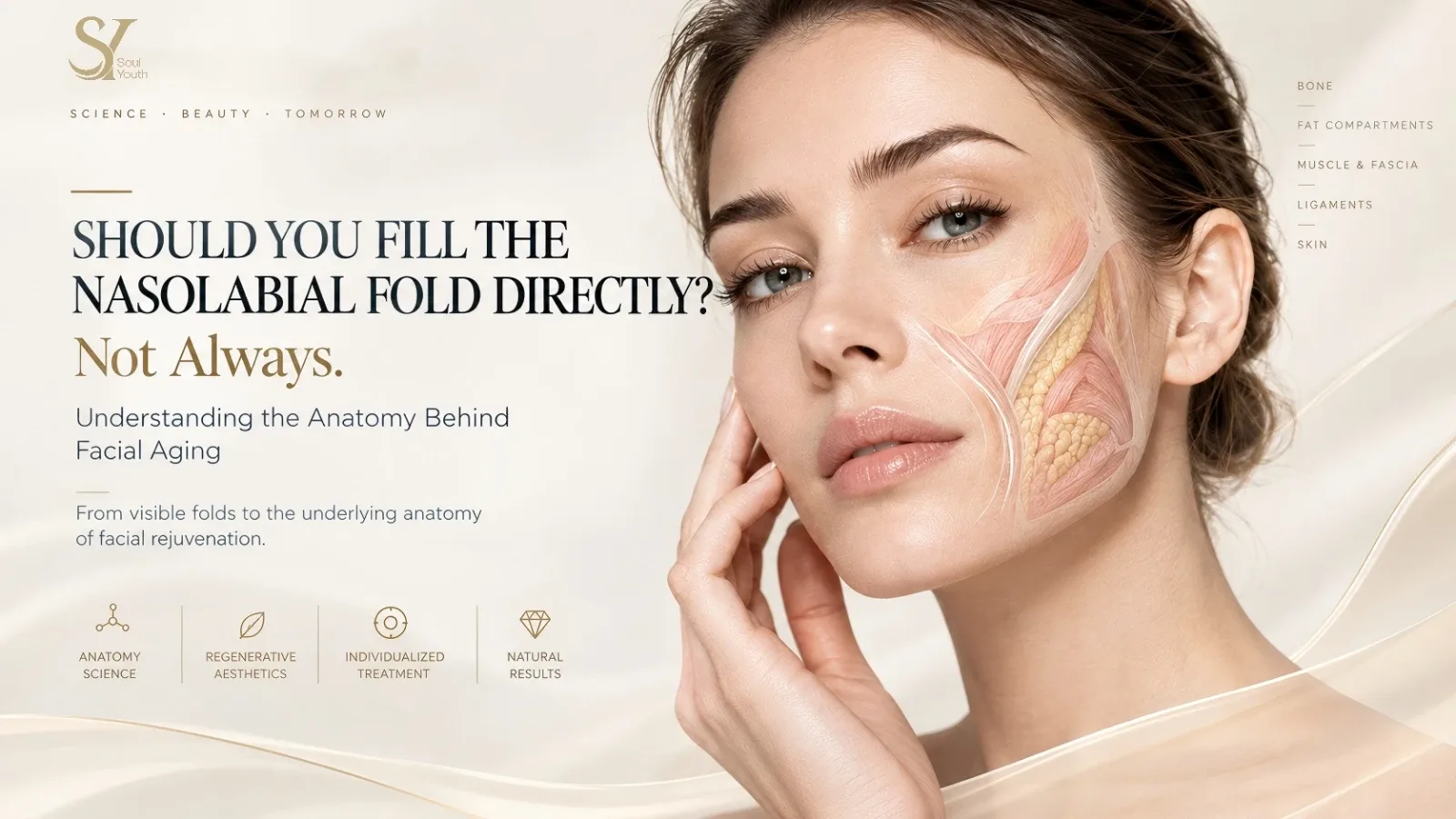
Should You Fill the Nasolabial Fold Directly? Not Always.
A prominent nasolabial fold does not always require direct filling. Facial aging involves multiple interconnected structures, including bone, fat, soft tissue, ligaments, and skin. A more thoughtful approach is to first understand the underlying anatomy and then determine the appropriate strategy for structural support, volume correction, and skin quality improvement. The goal is not simply to fill a line, but to understand the structure and restore facial balance.
A prominent nasolabial fold is one of the most common concerns in facial aesthetics.
The intuitive approach seems simple:
The fold is deep → add volume to the fold.
But facial aging is rarely that simple.
The nasolabial fold is not an isolated line on the face. Its appearance is influenced by the interaction between skin, superficial and deep fat compartments, retaining structures, facial muscles, soft-tissue movement, and underlying skeletal support.
This leads to a more important clinical question:
Is the visible fold the primary problem — or is it the visible consequence of changes occurring around it?
Understanding this distinction can fundamentally change how facial rejuvenation is evaluated.
01 | A Nasolabial Fold Is More Than a Surface Line
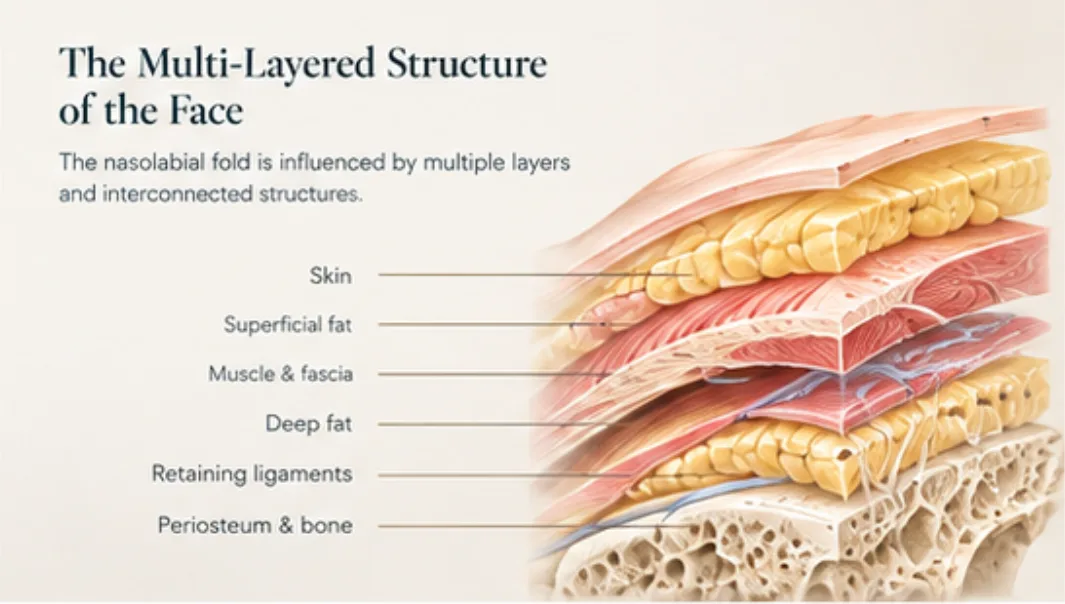
The face is organized into multiple anatomical layers rather than one continuous soft-tissue layer.
These include:
Skin
Superficial fat compartments
Muscles and fascial structures
Deep fat compartments
Retaining structures
Periosteal and skeletal support
Facial aging can affect several of these structures simultaneously.
Anatomical studies have demonstrated that facial fat is divided into distinct compartments, while changes in soft tissue, facial skeleton and fat distribution all contribute to the morphology of the aging face.
Therefore, a prominent nasolabial fold should not automatically be interpreted as a simple localized volume deficit directly beneath the fold.
02 | What Happens to the Midface With Age?
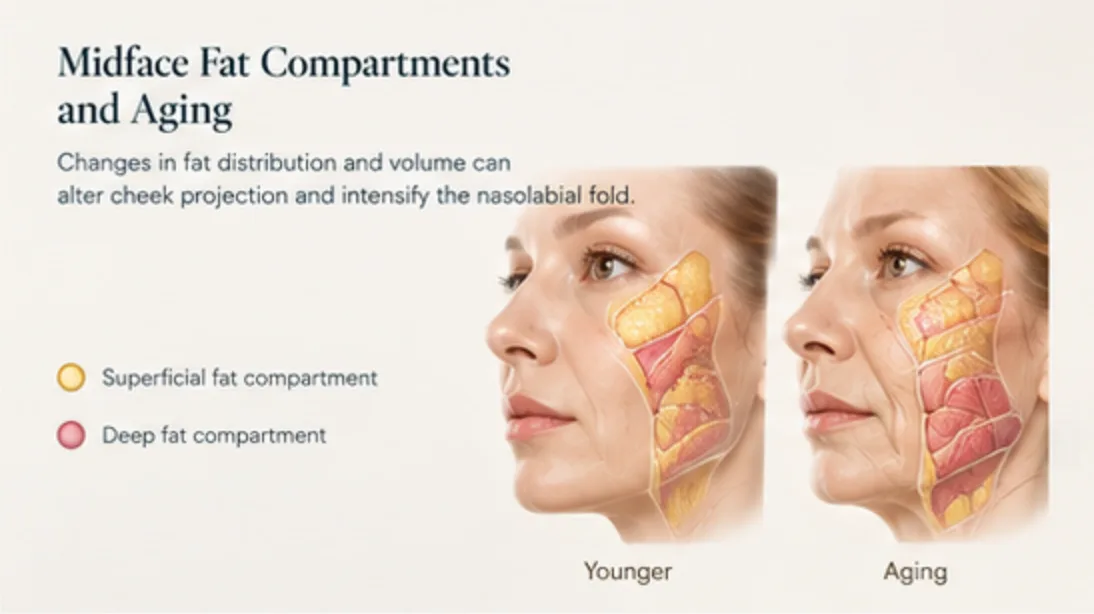
One of the important developments in facial anatomy has been the recognition that midfacial fat is compartmentalized.
The midface contains distinct superficial and deep fat compartments with different anatomical relationships and aging patterns.
Research has described age-related changes in these compartments, including alterations in deep and superficial fat distribution. Such changes can modify cheek projection and contribute to the increasingly visible boundaries between adjacent anatomical regions.
This means that a deeper nasolabial fold may sometimes reflect changes in the surrounding midface architecture, rather than an isolated deficiency within the fold itself.
That distinction matters.
03 | Why Midface Support Should Be Assessed First
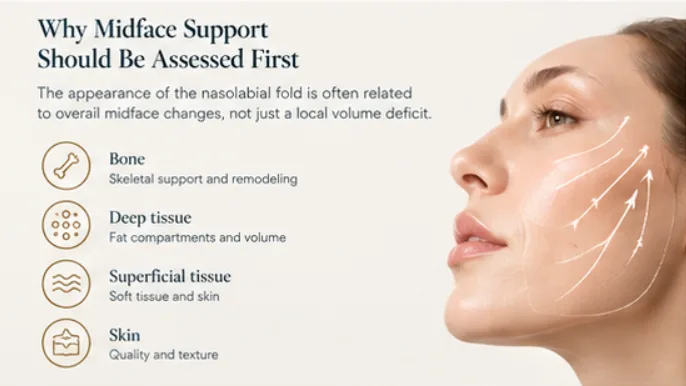
Consider the midface as a three-dimensional structure.
The relationship between:
Bone → Deep tissue → Superficial tissue → Skin
changes as the face ages.
Skeletal remodeling, changes in fat compartments and alterations in soft-tissue support can occur together. The literature increasingly describes facial aging as a multifactorial process, rather than a simple consequence of gravity alone.
This provides a rationale for evaluating the midface before deciding whether the nasolabial fold itself requires correction.
The clinical logic becomes:
Assess support → assess tissue distribution → assess the fold → determine the appropriate intervention
rather than:
See a line → fill the line.
04 | Does This Mean the Nasolabial Fold Should Never Be Filled Directly?
No.
This distinction is important.
Direct treatment of the nasolabial fold can be effective.
A systematic review and meta-analysis of randomized clinical trials found that tissue fillers can provide significant and sustained aesthetic improvement in the nasolabial fold area. A more recent network meta-analysis of randomized controlled trials also found evidence supporting the efficacy of fillers for nasolabial fold correction.
Therefore, the argument is not:
“Never fill the nasolabial fold.”
The more scientifically appropriate principle is:
Do not assume that every prominent nasolabial fold has the same anatomical cause.
If the primary issue is localized volume deficiency, direct correction may be appropriate.
If the fold is associated with changes in midface volume, tissue position, skeletal support, or multiple factors, a broader assessment may be more appropriate.
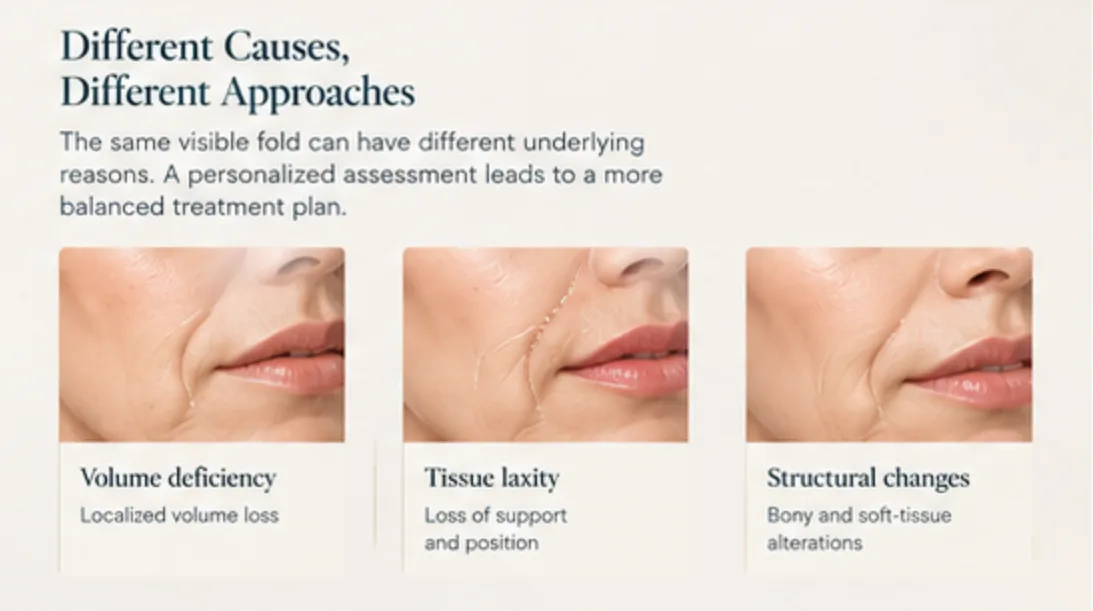
05 | Different Anatomies Can Produce a Similar Fold
Two people may have similarly prominent nasolabial folds but completely different underlying anatomy.
One may have:
Localized volume deficiency
where the visible depression is predominantly related to a regional lack of volume.
Another may have:
Midface volume change
where altered cheek volume changes the transition between adjacent compartments.
Another may have:
Soft-tissue laxity or positional change
where changes in tissue support contribute to the prominence of the fold.
And many patients may have a combination of these factors.
This is why facial aging should be evaluated as a three-dimensional and multidimensional process, rather than by the depth of one visible line alone.
06 | Why Overcorrection Can Become an Issue
If the underlying problem is not purely a local volume deficit, repeatedly adding volume directly into the fold may not produce the most balanced result.
The goal of facial rejuvenation is not simply to make a line disappear at rest.
A broader assessment considers:
Facial proportions
Tissue transitions
Dynamic facial movement
Overall facial balance
Skin and tissue quality
Long-term aesthetic objectives
Anatomical approaches to facial rejuvenation emphasize the importance of understanding individual fat compartments and structural relationships rather than treating the face as one homogeneous volume.
In other words:
The deepest line is not necessarily the first place that needs volume.
07 | A More Useful Assessment Framework
For a patient presenting with prominent nasolabial folds, a simplified conceptual framework can be:
1. Assess
Evaluate overall facial anatomy, tissue quality, volume distribution and dynamic movement.
2. Understand
Identify whether midface structure, soft-tissue distribution or localized deficiency contributes to the visible fold.
3. Correct
Address the relevant anatomical deficiency when clinically appropriate.
4. Refine
Reassess the overall facial balance rather than focusing solely on the original line.
This is not a universal treatment algorithm.
It is a way of thinking.
08 | From “Filling the Fold” to “Understanding the Face”
This reflects a broader evolution in aesthetic medicine.
Earlier treatment concepts often focused on individual visible problems:
Wrinkle → filler
Fold → filler
Volume loss → filler
Modern anatomical research has encouraged a broader perspective.
Facial aging involves interactions among:
Bone + Fat + Soft Tissue + Muscle + Skin
Changes in one anatomical component can alter the appearance of neighboring structures.
Therefore, facial rejuvenation is increasingly being considered not simply as the correction of individual lines, but as the restoration of relationships between anatomical structures.
09 | The Bigger Picture
A prominent nasolabial fold does not automatically mean:
“Fill the nasolabial fold.”
Sometimes the fold itself is the primary concern.
Sometimes it reflects changes in the surrounding midface.
And often, several factors coexist.
The more we understand facial anatomy, the more important this distinction becomes.
The future of aesthetic medicine may therefore be less about asking:
“Where should we inject?”
and more about asking:
“What structural and biological changes are contributing to this appearance?”
Because natural rejuvenation is not simply about filling a line.
It is about understanding the face as an interconnected system.
Conclusion
The most sophisticated approach to facial rejuvenation is not necessarily the one that uses the most product.
It is the one that begins with the most accurate understanding of the patient's anatomy.
Assess the structure.
Understand the tissue.
Identify the cause.
Then determine the appropriate correction.
This shift — from treating visible lines to understanding the underlying anatomy — is one of the important directions in modern aesthetic medicine.
At Soul Youth, we believe that continued progress in medical aesthetics depends not only on developing new injectable technologies, but also on improving our understanding of tissue biology, facial anatomy and individualized treatment strategies.
The goal is not simply to fill a fold.
The goal is to understand why it is there.
Medical Disclaimer
This article is intended for educational and professional discussion purposes only. It does not constitute medical advice, diagnosis, or a treatment recommendation. Facial anatomy and the causes of nasolabial fold prominence vary between individuals. Any aesthetic treatment should be assessed and performed by appropriately trained and licensed healthcare professionals in accordance with applicable local laws, approved product labeling, professional guidelines, and individual patient needs. The information presented here should not be used as a substitute for clinical training, anatomical assessment, or professional medical judgment.
References & Scientific Evidence
1. Rohrich RJ, Pessa JE. The Fat Compartments of the Face: Anatomy and Clinical Implications for Cosmetic Surgery.
Plastic and Reconstructive Surgery. 2007;119(7):2219–2227.
This foundational anatomical study describes the compartmental organization of facial fat and its relevance to facial aging and rejuvenation.
PubMed — The Fat Compartments of the Face
2. Gierloff M, et al. The Clinical Importance of the Fat Compartments in Midfacial Aging.
This review discusses the relationship between facial fat compartments, skeletal changes and soft-tissue aging, supporting a multifactorial model of midfacial aging.
3. Li Y, Liu D. Progress of Midfacial Fat Compartments and Related Clinical Applications.
This review summarizes anatomical research concerning superficial and deep midfacial fat compartments and their changes with aging.
4. Stefura T, et al. Tissue Fillers for the Nasolabial Fold Area: A Systematic Review and Meta-Analysis of Randomized Clinical Trials.
Aesthetic Plastic Surgery. 2021;45:2300–2316.
This systematic review and meta-analysis supports the clinical efficacy of tissue fillers for nasolabial fold correction and is important evidence against an overly absolute “never fill the fold” position.
PubMed — Systematic Review & Meta-analysis
5. Li M-Y, et al. Efficacy and Safety of Fillers for the Treatment of Nasolabial Folds: A Network Meta-Analysis of Randomized Controlled Trials.
Aesthetic Plastic Surgery. 2024;48:3452–3462.
This network meta-analysis included 13 randomized controlled trials and evaluated the efficacy and safety of different fillers for nasolabial folds.
PubMed — 2024 Network Meta-analysis
6. The Science and Theory Behind Facial Aging.
This review discusses the interaction of facial fat compartments, skeletal remodeling, retaining structures and soft-tissue changes in facial aging.
Specifications, terms and registration status.
Our team supports licensed clinics, distributors and OEM partners — tell us what your market needs.