3 September 2026
Staged Approaches to Regenerative Injectables: From Skin Foundation to Structural Refinement
Regenerative aesthetics is evolving beyond immediate volume replacement toward a more comprehensive approach to skin quality, collagen regeneration, and facial structural refinement. This article explores how different regenerative injectables can be incorporated into a staged treatment pathway, progressing from skin foundation and overall rejuvenation to targeted contour refinement. Rather than viewing each product as an isolated treatment, a structured approach considers product selection, treatment sequencing, and individual patient needs to create a more personalized rejuvenation strategy. Actual treatment decisions should always be guided by individual assessment, product labeling, applicable regulations, and professional clinical judgment.
Regenerative aesthetics is reshaping the way injectable treatments are approached.
Rather than focusing solely on immediate filling or volume enhancement, regenerative injectable strategies increasingly consider skin quality, collagen support, tissue structure and progressive improvement.
Because different injectable materials have different characteristics and intended roles, a thoughtful treatment plan may involve sequencing treatments across different stages rather than combining everything at once.
This article is intended for licensed healthcare professionals as general reference. It outlines a framework for considering regenerative injectables within staged treatment plans rather than as isolated interventions. Actual treatment decisions should always follow the applicable product instructions, indications, contraindications, local regulations and professional clinical judgement.
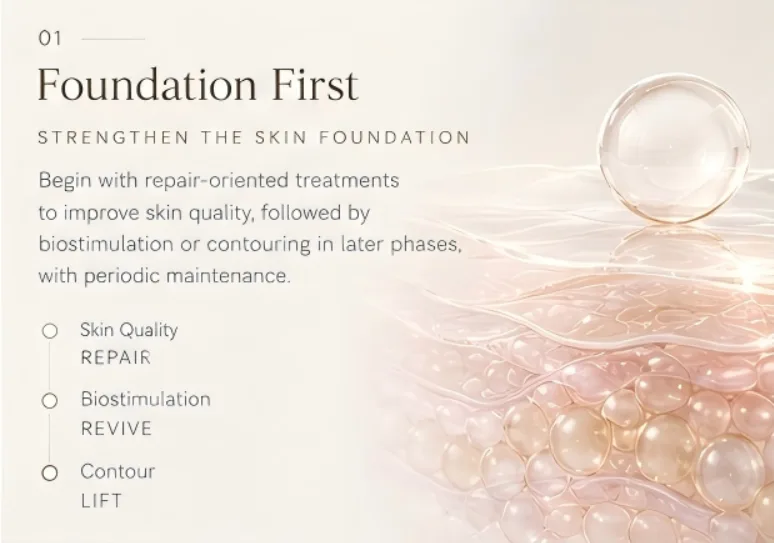
01 | Foundation First
Building the Skin Foundation
Before addressing deeper biostimulation or contouring, a common approach is to first consider the overall condition of the skin.
For patients presenting with concerns related to skin quality, hydration, texture or overall skin condition, repair-oriented skin treatments may be considered during an initial series.
Once the skin foundation has been addressed, subsequent stages can be considered according to the patient's individual needs, including biostimulation or contour-focused treatment.
The principle is simple:
Assess the foundation first, then determine what comes next.
Within the Soul Youth portfolio, for example:
REPAIR may be considered when the treatment focus is skin quality and repair-oriented care.
Subsequent stages may incorporate biostimulation or contour-oriented approaches according to the patient's condition and treatment objectives.
Periodic maintenance can then be considered based on treatment response and long-term goals.
Specific use should always follow the applicable product instructions and professional clinical judgement.
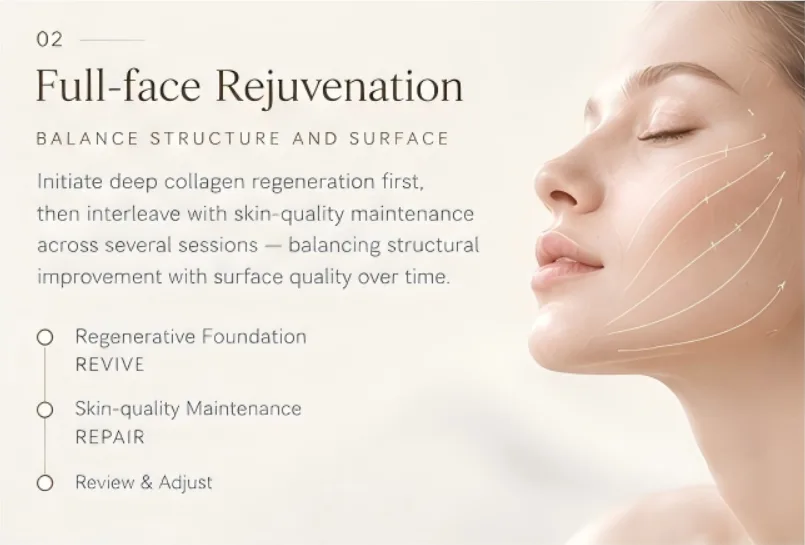
02 | Full-Face Rejuvenation
Moving Beyond Local Correction
Full-face rejuvenation is not simply about treating one wrinkle or adding volume to one area.
With age, changes can occur across skin quality, collagen support, soft-tissue structure and facial contours. For comprehensive rejuvenation, these dimensions may therefore be considered together when developing a staged treatment plan.
A possible framework includes:
Stage 1 — Regenerative Foundation
Initiate an appropriate biostimulation strategy according to the patient's condition and treatment objectives.
Stage 2 — Skin-Quality Maintenance
Introduce skin-quality-focused treatments between treatment stages where appropriate, allowing structural improvement and surface quality to be considered together.
Stage 3 — Review and Refine
Reassess treatment response, recovery and evolving aesthetic goals before determining subsequent treatment.
This approach views full-face rejuvenation as a progressive treatment process, rather than the result of a single product or isolated session.
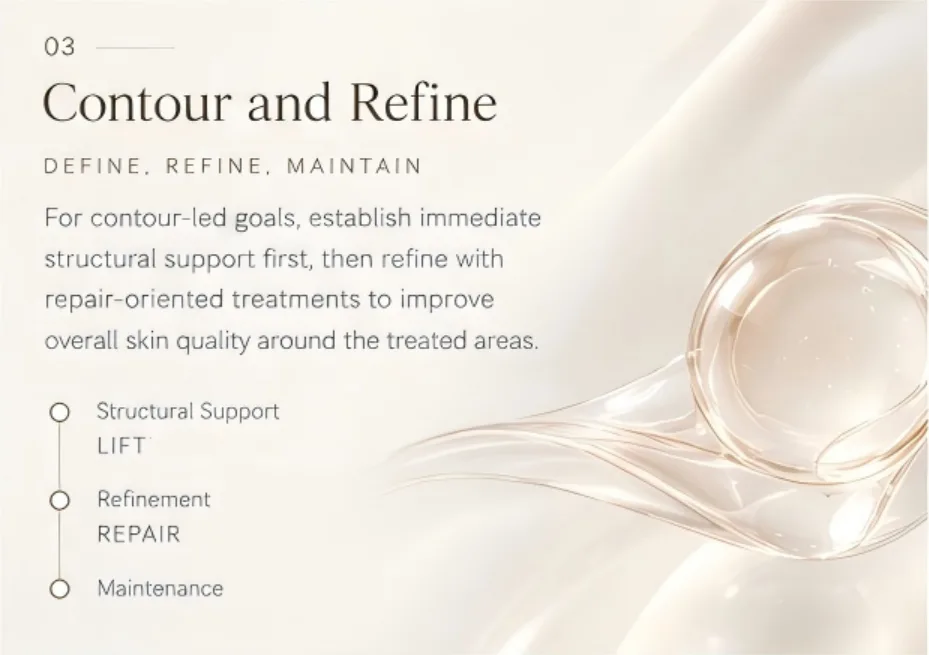
03 | Contour and Refine
Establish Structure, Then Refine the Result
When the primary objective is facial contouring, structural support and definition may become the initial focus.
Once the primary structural objective has been addressed, subsequent treatment can focus on the surrounding skin quality and overall harmony of the treated area.
The concept can be summarized as:
Define → Refine → Maintain
Define
Assess facial anatomy, soft-tissue characteristics and the patient's aesthetic objectives to determine the areas requiring attention.
Refine
In subsequent stages, repair-oriented approaches may be considered to support overall skin quality around the treated areas.
Maintain
Develop an appropriate maintenance strategy according to treatment response and the patient's longer-term objectives.
The goal is not simply to add volume, but to create a more balanced relationship between contour, tissue support and skin quality.
04 | Why Consider a Staged Approach?
Different Materials, Different Roles
Regenerative injectables are not necessarily designed to address every treatment objective in the same way.
Different materials have different characteristics, mechanisms, tissue considerations and intended uses. The key question when developing a treatment plan is therefore:
What does this patient need first?
Rather than:
How many products can be combined in one session?
A staged approach allows the practitioner to identify the priority at each phase and adjust subsequent treatment according to the patient's response.
Appropriate treatment intervals are equally important.
Combining multiple interventions at once does not automatically translate into better outcomes. Treatment intervals should be determined according to the relevant product instructions, treatment characteristics, treated areas and the patient's recovery.
05 | From Individual Products to a Treatment Pathway
Regenerative Aesthetics Is a Process
The value of regenerative aesthetics lies not only in individual products, but also in how different treatment objectives are organized into a coherent treatment pathway.
A comprehensive plan can be considered across three dimensions:
Skin Quality
Addressing overall skin condition, including hydration, texture and appearance.
Structural Support
Considering tissue support, facial architecture and contour relationships.
Regenerative Stimulation
Considering biostimulation approaches according to the characteristics and intended use of the selected product.
These dimensions are not mutually exclusive.
For full-face rejuvenation, they may be revisited across different stages. For contour-focused treatment, structural considerations may come first, followed by refinement of the surrounding skin quality.
The objective of personalization is therefore not simply to select more products, but to:
Choose the right treatment objectives and place them in the right sequence.
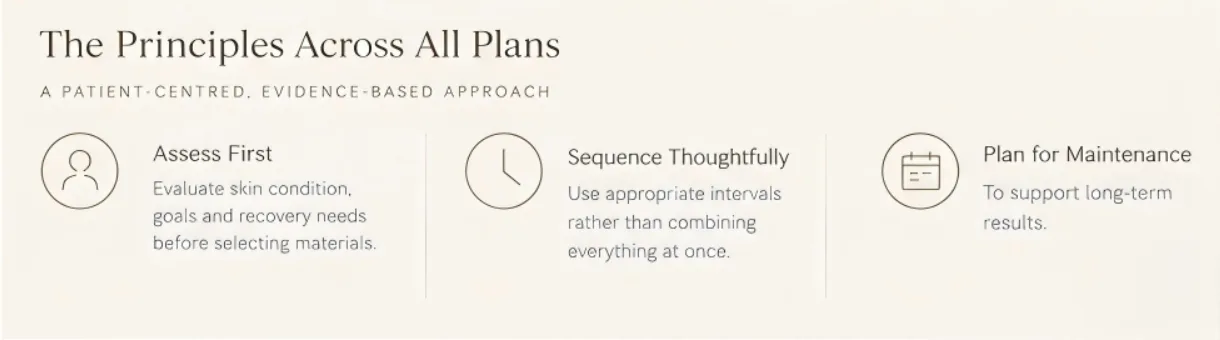
06 | Three Principles Across Treatment Plans
01 | Assess Before Selecting
Before selecting materials, assess:
Skin condition
Facial anatomy
Treatment objectives
Previous aesthetic treatments
Recovery requirements
Individual risk factors
Treatment planning should be based on the individual patient rather than a fixed protocol.
02 | Sequence, Don't Simply Stack
Different treatments should be appropriately sequenced rather than automatically combined in a single session.
Intervals should take into account the applicable product instructions, treatment characteristics, treated areas and patient recovery.
A staged approach can help practitioners:
Observe treatment response more clearly;
Adjust subsequent treatment when appropriate;
Avoid unnecessary simultaneous interventions;
Build a more structured long-term treatment pathway.
03 | Plan for Maintenance
Treatment is not necessarily the endpoint.
Regenerative approaches often emphasize progressive changes over time. Following an initial treatment series, future maintenance can be considered according to the patient's response and longer-term objectives.
Maintenance does not necessarily mean a fixed schedule or a fixed product.
A more individualized framework is:
Assess → Treat → Review → Maintain
The treatment plan can then evolve with the patient's condition and goals.
07 | Individualized Planning, Not a Fixed Template
Every face has different tissue characteristics, patterns of aging and treatment objectives.
Therefore, a staged approach should not be interpreted as a universal protocol. Instead, it provides a clinical decision-making framework.
For some patients, treatment may begin with skin-quality improvement.
For others, structural support and contour may be the initial priority.
For patients seeking comprehensive rejuvenation, structural and skin-quality considerations may be addressed across different stages.
There is no single protocol for every patient.
What matters is understanding the role of each treatment and developing an appropriate sequence based on the individual patient.
08 | Conclusion
Beyond Filling. Toward Regeneration.
Modern aesthetic medicine is moving beyond a purely filling-based approach toward a more comprehensive consideration of tissue quality and regeneration.
From skin foundation to biostimulation,
from structural support to contour refinement,
and from initial treatment to long-term maintenance.
Regenerative aesthetics is not a single treatment. It is a process.
Soul Youth is committed to developing regenerative injectable solutions supported by formulation science, quality-focused manufacturing and clinical evaluation, designed to support healthcare professionals across different aesthetic treatment objectives.
Soul Youth
Science. Evidence. Regeneration.
Professional Disclaimer
This article is intended for licensed healthcare professionals as general educational reference only. It does not constitute medical advice, diagnosis or an individualized treatment recommendation.
Specific indications, administration methods, injection depth, dosage, treatment intervals, contraindications, warnings and potential risks must always be determined according to the applicable product instructions and local regulatory requirements. All treatment decisions should be made by appropriately qualified healthcare professionals based on individual patient assessment, clinical judgement and the applicable product information.
Specifications, terms and registration status.
Our team supports licensed clinics, distributors and OEM partners — tell us what your market needs.